Illustrative & Storybook Art
Slide shows offer a partial selection of my artwork with provision to purchase high quality Giclee canvas prints.
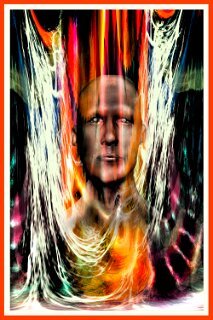
This image arrives with the force of a vision — not a quiet one, but the kind that shakes the body awake and leaves the air charged afterward. A male figure, shaved-headed and stoic, occupies the vertical center of the composition, his expression one of absolute inner stillness even as the world around him erupts into a torrent of light, flame, and energy. The contrast between that composed, almost monumental face and the explosive chromatic forces surrounding it is the work’s central drama, and it is rendered with an intensity that feels genuinely transformative. This is not a portrait of a person so much as a portrait of a process — the ancient, terrifying, ecstatic process of awakening.
The energy field that engulfs the figure is a masterwork of digital expressionism. Ribbons of white light spiral and surge upward from below, intertwining with cascades of deep crimson, molten orange, and electric yellow in a composition that unmistakably evokes the Kundalini of Hindu and yogic tradition — the serpentine life force said to rise through the body’s energy centers from the base of the spine to the crown of the head. The movement is both upward and outward, as though the figure is simultaneously a conduit and a source, the energy passing through him while also emanating from him. Streaks of cooler green and teal at the edges suggest the world beyond the transformation — present, but peripheral, held at a respectful distance.
The red border that frames the composition is a quietly brilliant formal decision, containing this eruption of energy within a defined field and preventing the image from dissolving into pure abstraction. It functions like the walls of a ritual space — marking the threshold between the ordinary and the sacred. The title Kundalini, if this is indeed the artist’s intent, is worn with full commitment: this is not a decorative reference to spiritual tradition but a genuine attempt to render the ineffable visible, to give form to an experience that language consistently fails to capture. It succeeds with rare and startling power.
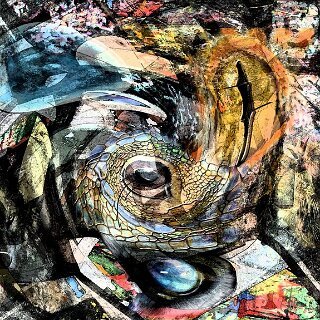
There are works of art that depict the world as it appears, and there are works that attempt to render the world as it feels from the inside — from within the spinning, dissolving, kaleidoscopic interior of a consciousness fully unmoored from the ordinary. This image belongs emphatically to the second category. A great vortex dominates the composition, pulling every element of the surrounding visual field into its gravitational center with irresistible force. Fragments of landscape, texture, color, and form — rocks, earth, sky, organic matter — are caught in its rotation, stripped of their individual identities and reconstituted as pure visual energy. To look at it is to feel the ground shift beneath one’s feet.
The technical construction is as ambitious as the conceptual vision. A mosaic-like spiral structure forms the vortex’s core, its tessellated surface suggesting both the scales of a living creature and the fractured geometry of a shattered mirror — something simultaneously natural and broken, organic and catastrophic. Around this central form, the surrounding field is a dense collage of painterly textures: warm ochres and rusts, cool blues and greys, flashes of green and gold that read as landscape glimpsed at speed. A single dark ovoid form — eye-like, pupil-like — sits within the spiral’s heart, lending the entire composition the unsettling quality of being watched from within the whirlwind itself.
The title Vision Quest frames all of this with precise intentionality. In Indigenous North American tradition, the vision quest is a rite of passage involving solitude, fasting, and the deliberate dissolution of ordinary perception in pursuit of deeper spiritual truth — an experience described consistently as overwhelming, disorienting, and ultimately revelatory. This image captures that phenomenology with extraordinary fidelity. The vortex is not destruction for its own sake; it is the necessary turbulence of transformation, the visual equivalent of a consciousness being taken apart and reassembled at a higher frequency. It is a bold, uncompromising, and deeply serious work — one that demands not just viewing but surrender.
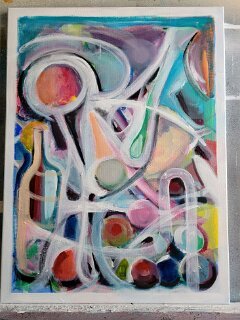
Caught again in that charged moment between intention and completion — the white canvas border still visible, the studio floor just glimpsed below — this painting radiates the particular electricity of a work in full creative flight, ideas arriving faster than the hand can fully resolve them and all the more vital for it. The composition operates as a kind of visual improvisation, a jazz performance in paint where the white gestural lines function as the melody: looping, doubling back, accelerating, pausing, tracing paths through the chromatic field with the spontaneous confidence of automatic writing. It is a painting that thinks out loud, and the thinking is exhilarating to follow.
Those white lines are the work’s animating force — fluid, calligraphic, and clearly drawn from a single sustained impulse rather than carefully plotted in advance. They describe forms that hover between the representational and the purely abstract: a circle that might be a lens or a portal, angular shapes that suggest arrows or architectural fragments, looping curves that recall both musical notation and the neural pathways of thought itself. Beneath and around these lines, the color field is richly layered — a luminous teal ground gives way to passages of deep violet, warm coral, soft pink, and acid yellow-green, with a cluster of spherical forms in the lower register that pulse like cells or planets or notes held just before resolution. The overall palette is cool and cerebral at the upper register, warming and becoming more sensuous toward the base — a chromatic arc that mirrors the movement from thought to feeling.
What the work ultimately evokes — and the filename Bandler may be a deliberate nod to Richard Bandler, the co-founder of Neuro-Linguistic Programming — is the internal architecture of a mind in the act of repatterning itself. The lines do not describe the world outside; they map the world within — the synaptic leaps, the recursive loops, the sudden clarities and productive confusions of a consciousness actively engaged in its own transformation. It is a painting about the process of thinking as much as about any particular thought, and in that ambition it achieves something genuinely rare: the sensation of being inside an idea as it forms.