Science Fiction
Quantum Soul: The Continuity Wars
Volume One
Science Fiction Dystopian Thriller by
Lawrence F. Peterson Ph.D.
© Copyright 2026, Lawrence F. Peterson
Science Fiction, Dystopian Thriller, Corporate Horror, Identity Fiction, Near Future Speculation.
Quantum Soul: The Continuity Wars explores chilling possibilities, plunging into Silicon Valley’s “move fast and break things” ethos colliding with the human soul. Part corporate thriller, part resistance manual, the novel questions consent, probing identity forked like software. Four companies claim different pieces of personhood—continuity, connection, choice, embodiment—raising ownership of the whole.
Melody’s captivity and Rachel’s witness build a devastating portrait, portraying “stability” as violence dressed in friendly UX design. Offering something rare in dystopian fiction: a practical resistance toolkit. Tapped rhythms. Paper trails. Strategic bureaucratic friction. Small refusals compound into system failure.
Science fiction feels uncomfortably close to our present—a world turning your soul into a subscription service, rendering “I refuse” the most dangerous sentence to speak.
Melody Vanguard triggers three different identity alarms at a train station, becoming living proof of the impossible: one person carrying four valid lives. AEON, CHOIR, ORACLE, and MNEMOSYNE hunt her signal, leading her to discover hidden infrastructure beneath society—Helios, a shadow system replicating people beyond mere tracking.
Detained in an underground facility, Melody learns her status as a key rather than a glitch. Helios manufactures more keys—instances bearing her face, her memories, her refusal to consent—shipped in cases marked with sun symbols to “Studio Hold” nodes across the city. Rachel, a clinician-turned-witness, aids her alongside an unlikely alliance of corporate rivals. Melody wages war through friction, refusal, and making her imprisonment expensive. In a world treating identity as infrastructure and engineering silence, her weapon emerges as a simple rhythm tapped on metal rails: Three beats. Pause. One beat.
Turning your soul into a service transforms refusal into revolution.
—
The Miracle Economy
QUANTUM SOUL: THE CONTINUITY WARS
Volume One: The Breach Point
Chapter 1 — The Gate
Melody Vanguard stepped off the commuter train carrying a coffee stain, a presentation she would never deliver, her mother’s voicemail tentatively unsaved on her phone, and the particular exhaustion of someone who stopped listening to music three years ago because silence felt better than songs reminding her of better versions of herself
“Sweetheart, I made your favorite. Sunday dinner. Don’t say you’ll try—just come.”
The message was three days old. She meant to call back. Meant to confirm. Meant to do a lot of things buried under quarterly reports and the particular exhaustion of being thirty-four and still not sure if her life belonged to her or the series of optimized choices she stopped questioning.
The coffee stain spread across the folder like a Rorschach test. Melody looked at it. Something else she she couldn’t fix before the meeting.
She promised her mother she would come to Sunday dinner three days ago. The voicemail sat in her phone like a stone. Her mother’s voice—warm, patient, displayed the familiar tone. “I know you’re busy, sweetheart, but I made your favorite,” deserved better than Melody’s perpetual “I’ll try.”
The mug was still in her apartment—chipped blue ceramic with a faded NPR logo from her college radio days. Every morning for twelve years she reached for that specific mug, even though she owned six others. A therapist once told her it was about control: choosing one small constant in a life feeling increasingly chosen for her. The mug exhibited a crack running down one side leaking if you filled it too full. She never filled it too full. She learned its limits the way you learn a person’s limits—through attention, through time, through the small catastrophes of daily intimacy.
Her mother gave her the mug. Freshman year, first week. “So you remember to listen,” her mother said. Melody didn’t understood then. She thought her mother meant listen to the radio, to the news, to the world. Only later she realized her mother meant: listen to yourself. Listen to the voice underneath all the other voices.
She hadn’t listened in a long time.
She meant to call back during lunch yesterday. Then the quarterly reports landed on her desk. Then her manager scheduled an emergency presentation for this morning. Then it was Monday night and too late to call. She promised to do it tomorrow. She would definitely do it tomorrow.
Tuesday morning. New Boston Central Station. The usual crush of bodies moved through turnstiles, phones raised, and faces blank with the particular exhaustion of people who stopped expecting their lives to improve.
Melody joined the flow. Her shoulder bag worn soft with use. Her shoes scuffed from walking too much. Her hair conspicuously needing a cut she budgeted for next month.
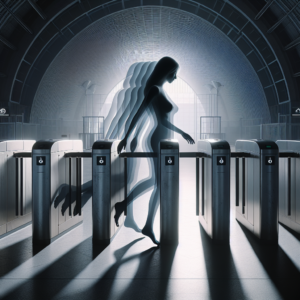
The ThreadSeal gate beeped once.
She paused, frowning. Her token sat in her pocket. It was paid through the end of the quarter. She checked the renewal notice last week. The charge cleared her account. The charge left her with enough for groceries if she skipped the coffee shop for the rest of the month.
The gate beeped again.
Melody pulled out her token, a small disc the size of a coin. AEON’s logo was etched into brushed metal. She held it to the scanner. The gate’s screen flickered.
CONTINUITY CONFLICT — DO NOT ADMIT
Around her, commuters slowed. Not stopping, not yet. Definitely creating space the way people do when they sense a problem. A growing circle of avoidance, phones already rising to capture the annoyance before understanding entered their reptilian brains.
Melody tried again. Her hands started shaking. She shoved them in her pockets.
The gate flashed red.
MULTI-THREAD SIGNATURE DETECTED
“I have work,” Melody said to the gate, her voice steady despite her stomach dropping. “Open. I can’t afford to be late.”
A security drone arrived first, hovering at eye level. Its four rotors rotated in whisper-quiet. Its camera tracked her face from multiple angles, building a real-time profile. It cross-referenced her thread, searching for discrepancies.
A CHOIR ambulance pulled up outside the station entrance. The staff wore soft colors and moved with practiced calm. They carried portable coherence rigs to prevent panic from spreading through crowds like contagion.
ORACLE municipal officers followed, faces tight, their hands hovering near nonlethal weapons. They positioned themselves at exits, blocking routes without appearing to block them. Their bodies angled to funnel people away from Melody, maintaining plausible deniability about containment.
The system treated Melody like a paradox or a pariah. Anomalies proved dangerous.
Melody treated it like a late train. An inconvenience requiring resolution to get to work and stop being the center of unwelcome attention.
The drone projected a soft voice, gender-neutral, algorithmically soothing. “Ms. Vanguard, please stand still. You present a multi-thread signature.”
Melody blinked. “I have one ThreadSeal. I paid for the premium plan.”
The drone paused, delivering bad news it didn’t want to deliver. “Your ledger contains mutually exclusive sequences.”
Melody’s phone buzzed. Her employer’s HR bot sent a single line:
Identity instability detected. Access suspended pending verification.
Verification meant holding rooms. Scans. Questioning. Delays. Missing work. Missing her presentation. Missing the meeting she prepared for all weekend. Explaining something she didn’t understand to people undoubtedly wouldn’t believe her.
Melody’s stomach tightened. Her hands started shaking harder. She shoved them deeper in her pockets.
Around her, commuters stepped back. A small circle of space opened, an unconscious quarantine. Nobody wanted drift contamination even if scientists insisted it was impossible. Fear ignored footnotes. Fear perceived a woman stopped at a gate with imagined contagion. With imagined instability spreading like a virus. Commuters imagined their own threads corrupting from proximity.
Better to keep distance. Better to record from safety. Better to watch than help.
A CHOIR medic approached, palms open, gesturing nonaggression like calming a wild animal. Young guy, maybe twenty-five, with kind eyes and the patient expression of someone trained to de-escalate crisis situations. “Melody, we can help you regulate. Breathe with me.”
“My breathing is fine,” Melody said.
She wasn’t fine. Her heart raced. Her vision narrowed. Her breath came too fast. But she didn’t want help from CHOIR. She didn’t want to be synced into calmness. She didn’t want her panic absorbed by complete strangers forming a metaphysical daisy chain. She wanted to understand what was happening. Wanted it fixed. Wanted to go to her low-paying job euphemistically called work.
An ORACLE officer spoke into an earpiece. His voice low but audible in the quiet station. “Vector flags elevated. Possible branch bleed.”
The phrase hit the air like the stench from a discarded diaper.
Branch bleed belonged in research papers and conspiracy forums, not train stations. Branch bleed was theoretical, a mathematical possibility nobody took seriously. Branch bleed was the nightmare scenario bleeding timelines into each other. A person existing in multiple states simultaneously. Causality breaking down and reality becoming negotiable.
Melody’s ThreadSeal token warmed in her pocket, apparently disliking attention. She pulled it out and held it up. Proof of something. Hoping showing her token would make the gate open and the government ticks back away. Hoping it would make the alarms stop and return everything back to a tolerable sense of normal.
“Look,” she said, voice rising. “I am me.”
The AEON drone projected a second image beside Melody’s face.
Melody, smiling, older by a few years, with a scar on her chin. The image carried an AEON authenticity seal. Impossible to forge, requiring biometric verification and quantum encryption and a dozen layers of security nobody could fake.
Then it projected a third image.
Melody, younger, hair dyed red, holding a baby. Also sealed. Also authenticated. Also impossible.
Then a fourth.
Melody in a hospital bed, eyes closed, a MNEMOSYNE patch visible behind her ear. Sealed.
The crowd made a sound people make rejecting reality. The world presenting something fundamentally wrong and the unsophisticated mind recoiling. A collective intake of foul breath. A murmur of confusion and fear. Phones rose higher, recording everything, already uploading to social media, spreading footage across networks before anyone understood what they were seeing.
Melody stared at the images glimpsing strangers wearing her skin.
The woman with the scar looked like her but wasn’t. The woman with red hair looked like her but wasn’t. The woman in the hospital bed looked like her but certainly wasn’t. They carried her face, her bone structure, her features, but they were absolutely wrong. Versions of her existing in lives she never lived and never wanted to live.
“I never dyed my hair,” Melody whispered.
The CHOIR medic leaned closer, voice gentle. “You feel dissociation. We can—”
“No,” Melody snapped, then caught herself. She looked down at her hands, checking they belonged to her, verifying her own body was real. “I have one life. I remember one life. This is a system glitch. Fix it.”
The AEON drone spoke again, voice still calm, still soothing, still delivering impossible information like reading a weather report. “ThreadSeal indicates four valid continuities occupying one present location.”
The ORACLE officer swallowed, face pale. “Recommend containment. Recommend comms blackout. Recommend Helios protocol—”
He stopped.
Helios existed as rumor. A shadow regulator. A quiet consortium some said controlled all four corporations from above. Coordinating their activities, managing conflicts, ensuring systems worked together instead of tearing each other apart. Nobody admitted it on record. Nobody discussed it in public. Everyone in the industry knew the name, knew the stories, knew better to say it out loud where civilians could hear.
The MNEMOSYNE patch behind Melody’s ear blinked once. A tiny blue pulse, barely visible unless looking for it.
Somewhere far from the station, in a sealed lab, a researcher watched Melody’s biometric stream, whispering, “It’s real.”
In another tower, an AEON executive felt cold joy. Multi-thread meant AEON’s system worked too well. Finding continuities nobody paid for, detecting patterns nobody predicted, revealing something fundamental about identity the company could monetize.
In another city, a CHOIR director felt dread. Melody carrying multiple selves turned resonance circles into traps. People bonding to the wrong version, syncing with a continuity not actually present, creating coherence with ghosts.
In ORACLE headquarters, an analyst stared at the vector dashboard as probability bars bucked like animals. The future started to move, started to split, started to branch in ways models couldn’t predict. The system designed to handle uncertainty but not something as bizarre as this. Not a person existing in four states simultaneously. Not causality breaking down in a train station on a Tuesday morning when people queued for work.
Melody tried the gate again, stubborn as gravity. She didn’t understand what was happening but understood she needed to get through, needed to get to work, needed to maintain the routine holding her life together. She sensed this was more than a mere bump in the road.
The station lights went out.
Complete darkness. No emergency lighting. No exit signs. No phone screens. Everything went dark. Something or someone cutting power to the entire station, to the entire block, to something larger than anyone could see.
In the void, Melody felt a sudden, violent tug, not at her clothes, but at her very atoms. She felt the leather strap of her bag slip from her shoulder. Perhaps she just lost the sensation of it as the system flagged the leather and the synthetic fibers of her coat as “non-essential mass.” No smoke, no flash, no cinematic shimmer.
She reached for the MNEMOSYNE patch behind her ear, the only thing besides her own skin feeling anchored to her. As she edited out of reality, the last thing she felt was the patch burning with a high-frequency synchronization pulse. Then, only absence.
When the lights came back, Melody vanished.
No smoke. No flash. No cinematic shimmer. One blink, then emptiness where a tired commuter stood. The space she occupied empty. The air still. Her bag gone. Her coat gone. She gone, edited out of reality, the universe deciding she didn’t belong and removing her with surgical precision.
The drones hovered, confused. Their cameras showing nothing. Their sensors detecting nothing. One moment Melody Vanguard there, the next not. No transition. No explanation. Just absence.
The officers shouted into their radios, voices rising with panic. The CHOIR medics looked at each other, professional calm cracking. The crowd surged, then scattered like ants in rain, people running for exits, desperate to get away from whatever just happened, desperate to put distance between themselves and the impossible thing they witnessed.
On the station wall, a public screen meant for ads glitched into a single sentence, black letters on white:
FOUR ANSWERS. ONE COST.
The message stayed for exactly three seconds. Long enough for dozens of phones to capture it. Long enough for the words to burn into the minds of everyone still in the station. Long enough to spread.
Then the screen returned to a cheerful promotion for ThreadSeal family plans, showing a happy family smiling together, their continuity badges glowing green, their lives stable and verified and exactly what they were supposed to be.
—
Six months earlier, the world learned time spreads sideways.
In the old world, death arrived like weather. People prepared, complained, prayed, raged, then went. It came with a contract, a set of upgrade paths, a financing plan, a customer-success representative, and a quiet warning printed near the bottom:
Continuity not guaranteed under branch turbulence.
Most people never read the warning. Nobody wanted turbulence. Nobody wanted branches. Nobody wanted to imagine time as a cathedral instead of a hallway, all those vaulted chambers existing simultaneously, light streaming through windows facing different centuries, prayers echoing across decades never meant to touch.
Yet time refused to behave. Spilling into dimensions the old physics pretended didn’t exist, creating overlaps and echoes and strange resonances nobody could explain with equations alone.
The first sign came during a routine quantum-network calibration in an undersea facility off the Azores. Technicians expected clean noise. The usual static hum of particles refusing to commit to a single state until observed. Instead, their instruments produced a repeating pattern. Like a heartbeat. Like a song. Like a message almost formed. Syllables pressing against the membrane separating signal from meaning. A rhythm too structured for randomness, too alien for human origin, too persistent for equipment malfunction.
Engineers did what engineers always did. Building filters. Training models. Improving signal-to-noise ratios until the graphs looked publishable and the peer reviewers stopped asking uncomfortable questions. They repeated the experiment, then repeated it again with different hardware, different labs, different oceans. Atlantic, Pacific, Arctic. Hoping distance would break the pattern, proving it was just local interference, just equipment error, just cosmic noise dressed up as revelation.
The pattern returned.
Identical across hemispheres. Persistent across months. Patient, something waiting for humanity to catch up.
News anchors called it “the future talking,” voices bright with the kind of excitement reserved for stories nobody fully understood but everyone wanted to monetize. Priests called it “the veil thinning,” dusting off eschatology textbooks and scheduling extra services for congregations suddenly interested in the end times. Economists called it “an information shock,” calculating arbitrage opportunities in markets not yet formed. Politicians called it “a national security event,” meaning classified briefings and expanded surveillance budgets and laws written in closed sessions. Criminals called it “an opportunity,” possessing a certain clarity about human nature everyone else preferred denying.
Four corporations called it market creation.
AEON Ledger moved first, presenting its moves as inevitabilities rather than choices, describing gravity instead of building a cage.
Their glossy launch event streamed in every language across the planet with closed captions for dialects most governments pretended didn’t exist. A calm presenter stood in front of a wall of slow-moving light, photons arranged to suggest depth without promising anything concrete. Her posture suggested authority without aggression. Her smile suggested warmth without intimacy. Everything about her focus-grouped into a perfect approximation of feigned trustworthiness.
“Life is a story,” she said, her voice warm as herbal tea and smooth as a lie told so often it became indistinguishable from truth, even to her. “Stories deserve preservation.”
The statement landed softly, a hand on a shoulder. Comforting. Possessive. The kind of touch becoming a grip without anyone noticing the transition.
AEON sold preservation with an accountant’s grace. Not cryonics—too science fiction, too uncertain, too many frozen bodies in warehouses nobody wanted to discuss. Not uploading—too philosophical, too threatening to religious sensibilities, too close to admitting the soul might be software. Not promises of heaven—too obviously fraudulent, too legally risky, too much like the scams people already distrusted and for good reason.
Records. Continuity. Traceability.
A person’s identity reduced to a living ledger, updated every second through wearable sensors, neural interfaces, secure biometrics, and consent-scoped memory snapshots. Not full mind copies. AEON insisted it respected dignity. Ensuring a person could be recognized across medical events, memory loss, accidents, and the strange new category of time-related anomalies governments refused to name in public.
The technology worked through a distributed network of sensors embedded in everyday objects. Your phone tracking your location and communication patterns. Your watch monitoring your biometrics and sleep cycles. Your home assistant recording your voice and preferences. Your car logging your driving habits and destinations. Your credit cards mapping your purchasing behavior. Your social media capturing your relationships and beliefs. All tidy with group conformity assuring compliance.
The technical explanation—buried in documentation nobody read—was elegant in its simplicity: ThreadSeal didn’t store your consciousness or copy your memories. It tracked patterns. The unique rhythm of your decision-making. The signature of your attention. The way you moved through space and time and choice.
Every swipe of your phone created data points. Every purchase. Every conversation near a smart device. Every route you walked. Every hesitation before clicking. Every pattern of sleep and waking. The system assembled these fragments into a continuity signature—a mathematical model of “you-ness” that could be verified, authenticated, tracked across time.
The quantum encryption came in at the verification layer. When you presented your ThreadSeal token at a gate or a checkpoint, the system didn’t just check an ID number. It checked whether the pattern of the person standing there matched the pattern in the ledger. Whether your continuity signature was consistent with the person who walked through that gate yesterday, last week, last year.
It was brilliant, really.
It was also a cage dressed up as protection.
Because once the system knew your pattern, it could detect deviation. Could flag inconsistency. Could notice when you started making choices that didn’t match your historical signature.
Could notice when you started refusing.
And refusal, the system had learned, was the most dangerous pattern of all.