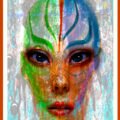
Dream Logic & The Impossible
Slide shows offer a partial selection of my artwork with provision to purchase high quality Giclee canvas prints.
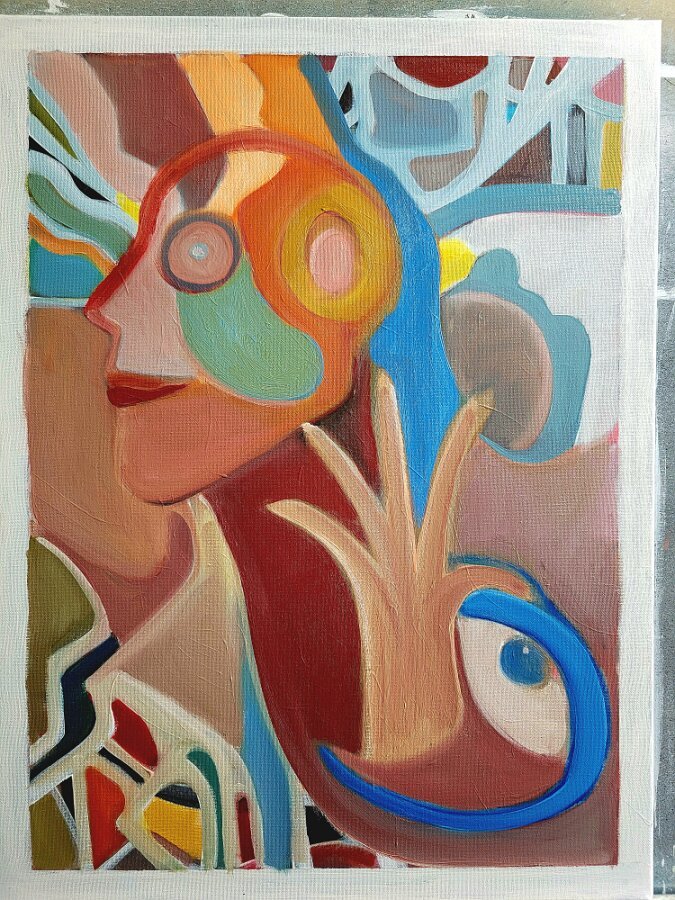
Caught in what appears to be a late stage of creation — the raw canvas edges still visible, the studio light falling naturally across its surface — this painting radiates the particular excitement of a work finding its final form. And yet there is nothing unfinished about its ambition or its confidence. A profile figure dominates the upper left, rendered in the flattened, interlocking planes of Synthetic Cubism, her auburn hair a bold halo of warm orange that anchors the composition’s emotional center. She gazes leftward with quiet resolve, her face a mosaic of sage green, blush, and terracotta — simplified to essence, yet unmistakably human.
The canvas is organized as a series of distinct but interconnected zones, each with its own visual logic that nevertheless speaks fluently to its neighbors. The lower left erupts into a stained-glass-like grid of jewel tones — olive, crimson, yellow, navy — that pulses with geometric energy. To the right, a cool cerulean river of form flows vertically, carrying the eye upward toward a fragmented upper corner of sky-like shapes and muted architectural echoes. Most striking is the lower right: a large, solitary eye rendered in vivid blue, coiled within a spiral of the same hue — watchful, surreal, and impossible to ignore. It functions as the painting’s conscience, a second gaze that observes both the figure and the viewer.
The work carries the unmistakable DNA of the great Modernists — Léger’s bold flatness, Picasso’s fractured portraiture, Matisse’s chromatic joy — yet synthesizes these influences into something with its own distinct pulse. The palette moves from warm to cool with the confidence of an artist who understands color not as decoration but as structure. This is a painting in conversation with art history while remaining entirely present tense — a vivid, intelligent, and deeply pleasurable work that announces a voice both learned and wholly its own.
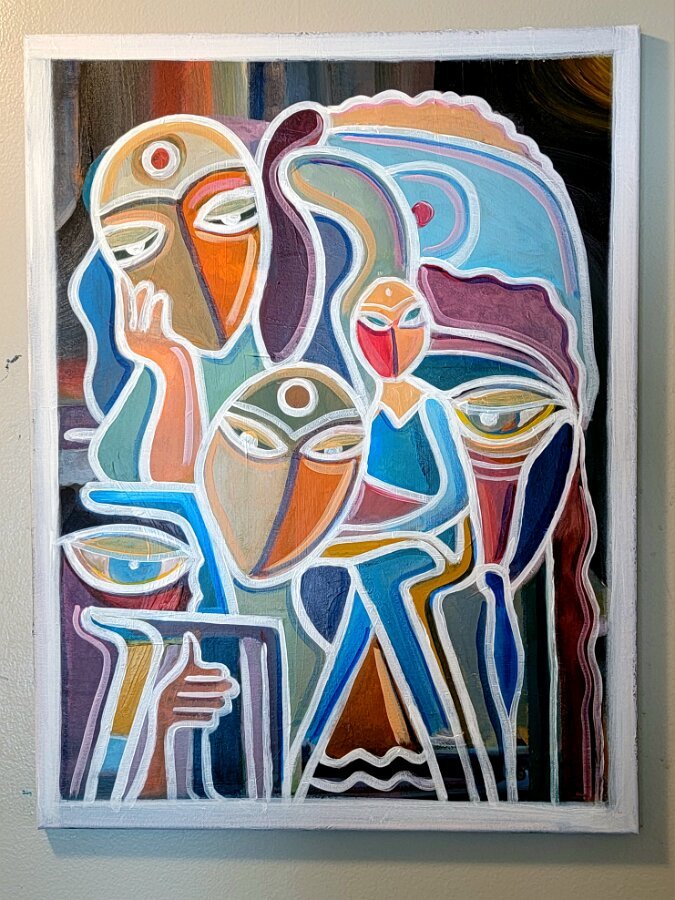
There is an immediate sense of gathering in this painting — of figures drawn together by some shared purpose or bond, their forms overlapping and interlocking in a composition that feels both ancient and urgently contemporary. Four mask-like faces populate the canvas, each distinct in expression and orientation yet unified by the artist’s bold white outlines that trace through the entire composition like a continuous, breathing line. The effect recalls the ceremonial art of West African traditions and the totemic figuration of Pacific Northwest Indigenous art, filtered through a thoroughly modern sensibility. This is a painting that knows its lineage and wears it with pride.
The white contour lines are the work’s defining formal achievement. Applied with confident fluidity, they simultaneously separate and connect the figures, creating a visual rhythm that moves the eye in a continuous circuit around the canvas. Within these outlines, the color fills are richly varied — warm terracottas and burnt oranges inhabit the larger figure at left, while cool blues and mauves define the forms to the right, the contrast suggesting complementary natures held in close proximity. A deep, painterly background of burgundy, slate, and near-black grounds the figures, giving them a luminous, almost stained-glass quality that elevates the scene toward the ceremonial.
What resonates most deeply is the painting’s quiet narrative charge. The figures do not merely coexist — they communicate, their gazes and gestures suggesting a conversation or ritual whose meaning hovers just beyond articulation. A hand offers a gesture of affirmation at the lower left; faces tilt toward one another with the attentiveness of long familiarity. This is a painting about connection — between people, between cultures, between the visible and the symbolic — rendered with a formal elegance that makes its emotional warmth feel entirely earned.
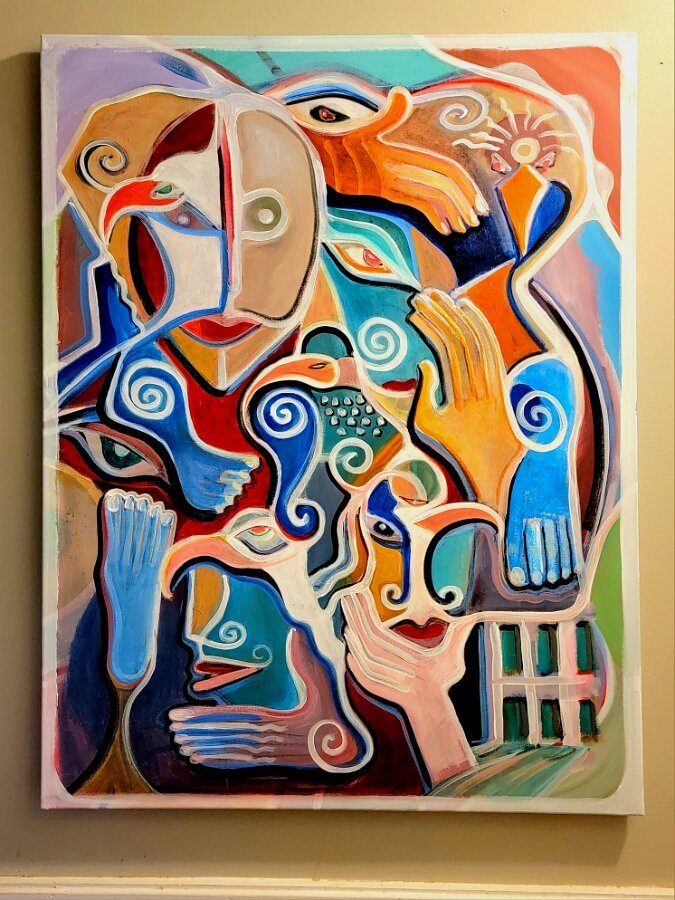
This canvas arrives like a chorus — multiple voices, faces, and hands erupting simultaneously into a composition of extraordinary vitality and controlled exuberance. Where some paintings invite quiet contemplation, this one demands full presence, its teeming surface pulling the eye across a landscape of interlocking figures, spiraling forms, and outstretched hands that seem to reach beyond the picture plane itself. It is a painting about multiplicity — of identity, of expression, of the human need to be seen and heard — and it delivers that theme with a formal confidence that is genuinely thrilling.
The artist’s signature white outlines return here with even greater expressive force, now tracing not just faces but hands, spirals, feathers, and architectural fragments in a continuous calligraphic flow that unifies the composition’s remarkable density. At least five distinct faces inhabit the canvas, each rendered in a different emotional register — contemplative, watchful, open, searching — and each embedded within a chromatic world of its own: deep cobalt blues, warm siennas, vivid teals, and bursts of coral and gold. Spiral motifs recur throughout like visual refrains, lending the work a rhythmic, almost musical structure. A sun symbol, a bird form, and a grid-like architectural element at the lower right suggest a world that extends beyond the purely personal into the mythological and the civic.
The hands are perhaps the painting’s most eloquent element. Rendered in soft pinks and blues, they appear throughout the composition — gesturing, supporting, reaching — and collectively they transform what might otherwise be a portrait ensemble into something closer to a statement about human interdependence. This is a painting that understands community not as a backdrop but as a subject worthy of the full force of artistic attention. Ambitious, generous, and alive with meaning, it stands as one of the most fully realized works in the series — a testament to an artist painting at the height of their powers.
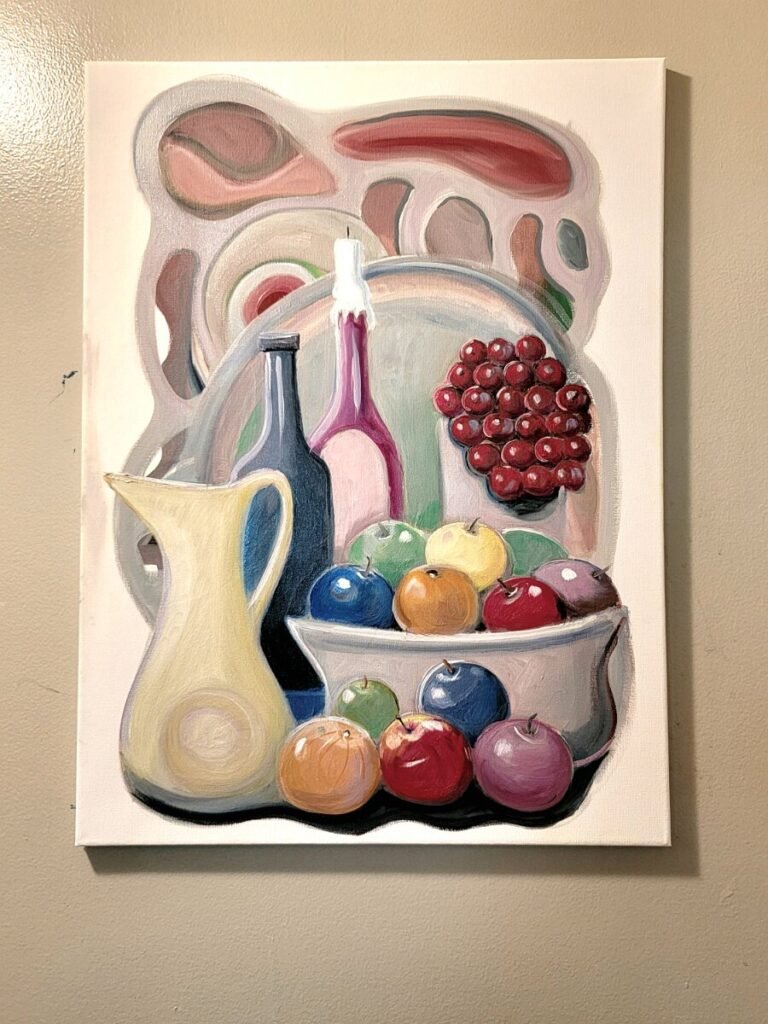
This painting offers a contemporary interpretation of still life, balancing recognizable domestic objects with a fluid, semi-abstract sense of space. The arrangement of fruit, bottles, and pitcher is carefully structured, yet the surrounding biomorphic forms soften the composition and give it a lyrical, almost dreamlike atmosphere.
Its compositional restraint recalls Giorgio Morandi, particularly in the quiet dialogue between vessels and the subtle harmony of tones. At the same time, the artist’s attention to rounded mass and spatial tension suggests a distant affinity with Cézanne, while the animated background brings to mind the decorative freedom of Matisse. These references are not imitative, but they help situate the work within a broader modernist conversation.
What makes the painting especially engaging is the way it moves between solidity and softness. The clustered fruit and vessels have weight and presence, while the flowing abstract backdrop opens the image into something more imaginative and atmospheric. The result is a still life that feels both grounded and inventive—an elegant fusion of classical subject matter and contemporary painterly expression.
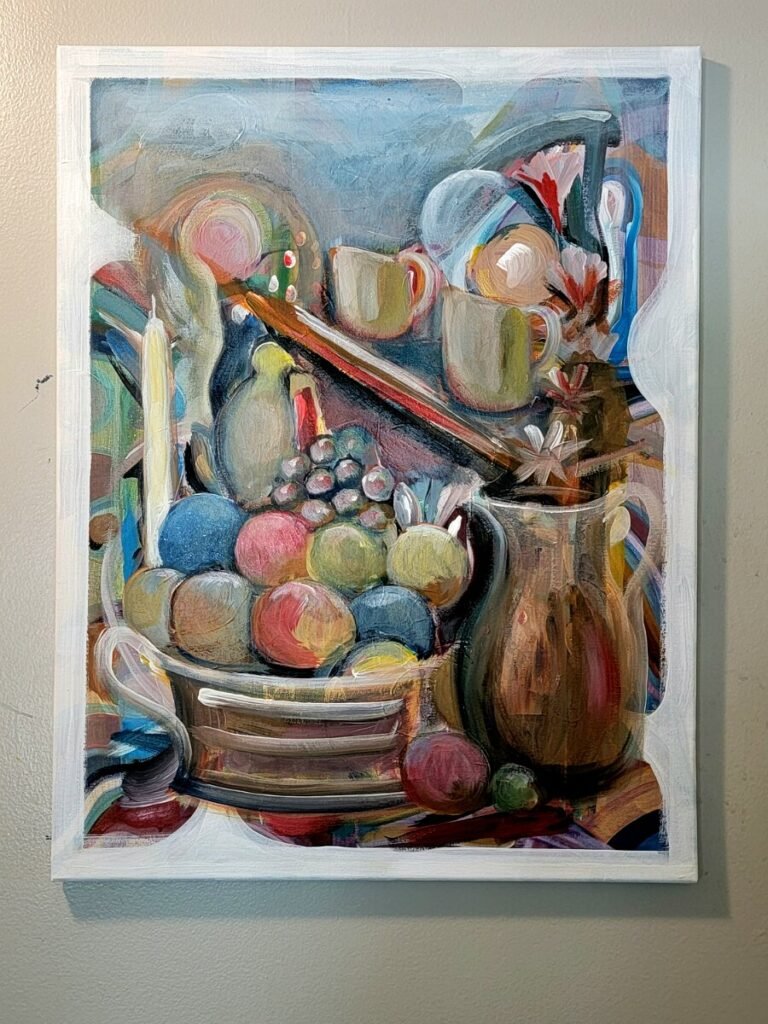
This painting expands the still life into something far more animated and immersive, layering cups, fruit, flowers, and reflective vessels into a composition that feels both abundant and unstable in the most compelling way. Rather than presenting objects in calm isolation, the artist builds a dense, shifting arrangement in which forms overlap, tilt, and echo across the surface, creating a lively sense of movement.
There are clear resonances with Cézanne in the way the composition is organized through volume, diagonal tension, and the precarious balance of tabletop space. At the same time, its fractured perspective and crowded interior suggest an affinity with post-Cubist still life, while the heightened color and energetic brushwork bring moments of Matisse and even the expressive freedom of contemporary figurative abstraction to mind. These comparisons are less about direct influence than about the painting’s place within a modern tradition of reimagining domestic objects as dynamic pictorial forms.
What distinguishes the work is its combination of structure and exuberance. The bowl of fruit anchors the lower register, while the cups, flowers, and dark vessel pull the eye upward and across the picture plane. Soft blues and muted earth tones are punctuated by brighter pinks, reds, and yellows, giving the composition both harmony and spark. The result is a still life that feels generous, painterly, and restlessly alive—rooted in observation, but transformed through color, rhythm, and invention.
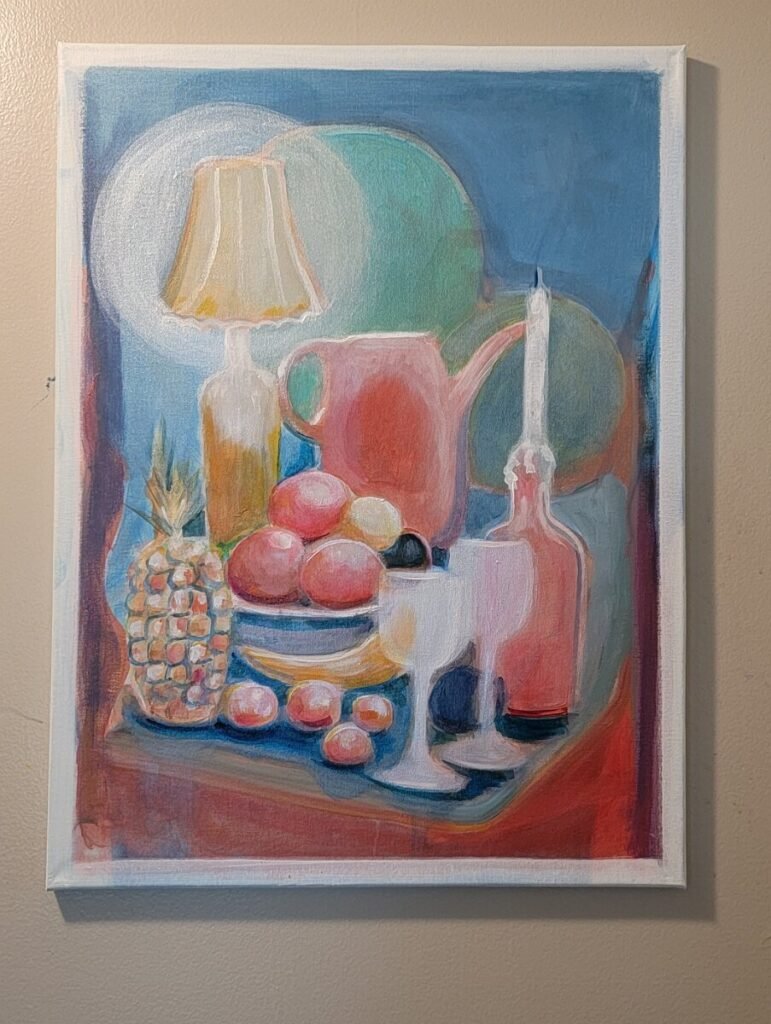
This painting approaches the still life with a notable sense of calm, reducing a tabletop arrangement of lamp, pitcher, bottles, fruit, and pineapple into a composition of softened silhouettes and luminous color relationships. Rather than emphasizing sharp detail, the artist allows each object to hover within a gently compressed space, giving the scene an atmospheric, almost meditative presence.
The work recalls Giorgio Morandi in its quiet poise and subdued orchestration of everyday forms, while its simplified contours and softly radiant palette suggest a dialogue with Matisse, particularly in the way color carries structure as much as line. There is also an echo of Cézanne in the stacking of volumes and the subtle instability of the tabletop plane, though here that structural tension is tempered by a more lyrical, contemporary softness.
What makes the painting especially effective is its balance between intimacy and abstraction. Large circular forms in the background create a spacious visual rhythm behind the more delicate arrangement of fruit and glassware, while pinks, blues, creams, and muted greens establish a palette that feels both fresh and restrained. The result is a still life of quiet intelligence—rooted in observation, but distilled into something more atmospheric, spacious, and modern.