
Dark Fantasy
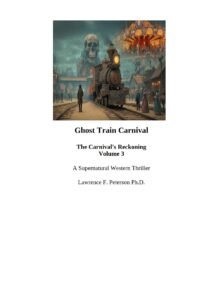
Ghost Train Carnival VOL3: The Carnival’s Reckoning
L.F. Peterson (C) Copyright 2026
THE CARNIVAL’S RECKONING
Sam Quick thought he escaped Eclipse Junction. He was wrong. The carnival doesn’t just steal children, it erases them. In storefronts across Kansas City, desperate parents sign contracts promising help, only to watch their children’s names vanish from their memories. What returns aren’t their sons and daughters, but perfect counterfeits designed to degrade and disappear.
Armed with a reaper blade and damning evidence, Sam drags the carnival into Hell’s own courtroom. But Lucifer didn’t build his empire on fair deals, he built it on the absence of Hope itself. To win, Sam must prove the entire system is fraud, even as the Sirens’ anti-music tears reality apart and Management sends collectors to reclaim what he’s freed. One arbitration. Winner takes all. Loser loses everything.
The children are counting on him. The parents are counting on him. And the carnival’s machinery is grinding toward its final, terrible purpose.
Some systems can’t be reformed. Some machines can only be destroyed.
“A supernatural legal thriller that asks: What happens when Hell tries to make damnation fair, and a man with nothing left to lose proves it’s still just theft dressed in paperwork?”
Ghost Train Carnival: Volume 3 – Where hope becomes the ultimate weapon, and one man’s fight for justice threatens to unmake Hell itself.
Perfect for readers who love:
– Supernatural Westerns with legal thriller elements
– Morally complex villains questioning their own systems
– High-stakes courtroom drama in impossible settings
– Stories where bureaucracy becomes horror
CHAPTER ONE: THE MORNING AFTER MIDNIGHT
Kansas City wakes up slow, its mornings heavy with coal smoke and the rumble of wagon wheels.
Sunlight strikes brick facades along Fifth Street, transforming soot-darkened windows into something resembling honest commerce. Pushcart vendors call their wares in practiced rhythms. Women cross intersections with market baskets hooked over their arms, skirts lifted high enough to clear mud and horse droppings accumulating in gutters. Children dart between adult legs with fearless velocity, their voices sharp against the low rumble of wagon wheels on cobblestone.
Behind it all, the rail yards exhale perpetual breath of coal smoke and hot iron. They form the mechanical heartbeat of a city built on the promise of westward expansion and the reality of backbreaking labor.
Sam Quick stands near the corner where commerce meets hunger. His hat brim shadows his eyes without obscuring vision. His Colt revolver sits in its usual place, the weight familiar against his hip. Out of habit, his hands remain close to it. His work brings different rules than gunfighting days. Rules bring leverage. Leverage keeps people alive, at least the ones he can reach before Hell’s machinery grinds them into something less than human.
Two doors down, a pawnshop displays watches and wedding rings behind grimy glass. Adjacent hangs a storefront sign: Eclipse Relief and Employment Foundation. Lace curtains soften the view inside. Beside the door, services are listed in neat script: Food Assistance, Medical Aid, Employment Placement, Financial Counseling. Services desperate people need. Services desperate people will sign almost anything to receive.
A line forms outside the Foundation every morning. It never truly ends, it simply changes faces. Mothers with hollow cheeks and children clinging to skirts. Men with hands ruined by factory work or farm accidents, their eyes carrying the specific shame of providers unable to provide. Boys too young for their shoulders to bear the weight they carry. They look for any work paying enough to keep families from the streets.
Sam watches a clerk standing at the door. A young man in a gray suit with a smile practiced to the point of becoming a mask. He offers clipboards to each person entering. He offers forms printed on cream-colored paper. He offers a pen with a gold nib, the kind of pen suggesting importance, legitimacy, transactions worth documenting properly.
A woman steps forward from the line. She’s perhaps thirty years old, her dress clean but worn thin at the elbows and hem. Her name is Ruth Calloway, though Sam doesn’t know this yet. Her son clings to her skirt with one small fist. The other hand presses against his mouth as he coughs into his sleeve. The cough is wet and rattling, the kind of sound suggesting consumption or pneumonia. It’s the sound keeping a mother awake at night, listening to her child struggle for breath and wondering which morning he won’t wake up.
The boy’s eyes watch the Foundation door the way animals watch traps. Some instinct deeper than reason warns him danger waits inside, despite promises of help.
Ruth grips the clipboard handed to her, her fingers trembling as she scans the form. Her son’s cough rattles through her resolve, and desperation overtakes her. She signs.”
The clerk watches her the way a butcher watches weight settle on his scale. His smile never breaks. His voice stays soft, practiced, kind enough to disarm suspicion without quite reaching warmth. A voice designed to disarm prey.
“Just sign at the bottom, ma’am,” he says, pointing to a line near the end of the form. “We’ll get you and your boy taken care of right away. Hot meal, medicine for his cough, and I believe we have a laundry position opening this afternoon. Good wages, respectable work.”
Ruth’s eyes move over dense paragraphs of text above the signature line. She’s literate enough to read the words but not educated enough to parse legal constructions hiding between them. Phrases like “consideration rendered in exchange for services provided” and “voluntary transfer of specified assets as enumerated in attached schedules” mean nothing to her except promises wrapped in official language suggesting legitimacy.
Her son coughs again, harder this time, his thin body shaking with the force of it. Ruth looks down at him. At a distance, Sam sees the desperation naked on her face, the kind of desperation making people sign anything, agree to anything, surrender anything if it means saving someone they love.
She signs. The pen’s gold nib scratches across the cream-colored paper. Ink sinks into fibers like blood into dust.
A bell rings somewhere inside the Foundation building. Not loud. Not sharp. A small sound. A service bell used by shopkeepers to signal a customer’s arrival. Polite. Professional. Utterly mundane.
Ruth blinks as if her eyes are trying to focus through sudden fog. Her son tugs her skirt.
“Mama,” he says.
Ruth looks down at him. Love lives in her face, fierce as any gunfighter’s stare. It’s the kind of love allowing mothers to lift wagons off trapped children. It’s the kind of love allowing mothers to walk into burning buildings without hesitation. But confusion moves in behind the love, a shadow crossing clear water.
Her mouth opens. No sound arrives. She tries again. Her lips shape empty air. Her tongue searches for a word every mother knows, the word anchoring a child to the world. The word she speaks a thousand times a day to her son.
The boy tugs harder. “Mama, what’s wrong?”
Ruth’s eyes shine with sudden tears. Her throat works. Her mouth forms the right shape, but her voice cannot find the sound. She tries again and again. Each attempt is more desperate than the last. She resembles a woman drowning who can see the surface but cannot reach it.
The clerk leans in, gentle and helpful, his manner suggesting nothing more sinister than assisting a customer with a difficult form.
“No need to worry, miss,” he says. “Names slip sometimes. Stress does it. Hunger does it. Our program will help you feel better. Why don’t you and the boy come inside? We’ll get you both settled.”
Ruth pulls her son close, her arms locking around him like a prison built from love and terror. She whispers into his hair, a stream of soft sounds, endearments and reassurances. None of them his name. She can’t remember his name. The word is gone from her mind as completely as if it never existed. In its place is a blank space, a hole where something precious once lived.
The boy stiffens in her arms. He begins to cry. Not the simple tears of a child wanting comfort. Deeper sobs of someone losing something he cannot name. Something fundamental to his existence is slipping away like water through cupped hands.
People in the line shift uneasily. They sense something wrong. Desperation roots them in place. They need what the Foundation offers. They need it badly enough to ignore the wrongness. They need it badly enough to tell themselves the woman is simply tired, overwhelmed, experiencing confusion from poverty and hunger.
Across the street, Sam watches the boy’s face change. He sees panic rise in his young eyes when identity loses its anchor. He sees the clerk’s pen, the gold nib catching sunlight. He sees the cream-colored paper too fine for charity work. He knows the watermark will be faint as an eclipse, visible only when held to the light.
He smells something being boiled down to syrup on a breeze carrying no carnival scent, no cotton candy or popcorn, just the repugnant sweet chemical smell of something rotting beneath perfume. He tastes copper at the back of his tongue, the way he tasted it in Eclipse Junction. The way he tasted it when Hell’s machinery operated nearby.
Sam Quick crosses the street.
CHAPTER TWO: THE THRESHOLD OF COMMERCE
Sam steps through the Foundation’s front door, hat in hand. His posture is relaxed in the way of a man who has survived gunfights by never appearing threatening until the required moment. His eyes map the room in three seconds: exits, corners, blind spots, the positions of every person present, the distance to each potential threat. Reading a room wrong means dying on a saloon floor while someone else walks away.
The interior looks simple by design. Wooden chairs line one wall, their seats worn smooth by countless desperate bodies. A water barrel sits in the corner with a tin dipper hanging from a nail. A counter divides the front area from the back offices, its surface polished to a shine suggesting more care than charity work typically receives. Clerks in gray suits move behind the counter with synchronized precision, each performing their assigned function without wasted motion or unnecessary conversation.
The air feels processed, undoubtedly filtered and sweetened. It carries a scent Sam can’t quite identify, something closer to the smell of a funeral parlor, an attempt to mask decay beneath a veneer of respectability. The sweetness coats his throat when he breathes, making him want to spit and clear his mouth of the taste.
Ruth Calloway sits in one of the wooden chairs, rocking her son as if the motion alone can restore what she lost. The boy sobs into her blouse, his small body shaking with grief he cannot articulate. A clerk kneels beside them, offering a handkerchief and a smile. He holds out a small tin of lozenges, the label reading Mercy Mints in elegant script.
Sam approaches the counter. A man waits there, his collar crisp and white, his nails far too clean and trimmed. His eyes carry the particular calm of someone who has never doubted his authority or his purpose. A brass nameplate on the counter reads Mr. Sable, Contract Administrator.
Sam keeps his face still. His voice is level, the tone of a man asking reasonable questions about unreasonable circumstances.
“Ruth Calloway signed an intake form,” Sam says. “Her boy lost his name inside her memory. No train. No platform. No ticket to Eclipse Junction. How does the carnival take without the ride?”
Mr. Sable’s smile carries professional warmth, the kind customer service representatives practice until it becomes indistinguishable from genuine courtesy. He speaks with the measured cadence of someone accustomed to explaining complex matters to simple people.
“Mr. Quick,” he says, and Sam feels his spine stiffen at the sound of his own name spoken aloud. “Welcome to our Foundation. Your presence honors our commitment to transparency and community engagement. We offer essential services to those in need, and in exchange we receive consideration. Consideration takes many forms depending on individual circumstances and assessed capacity. Consent remains central to all our operations. Jurisdiction remains clear and properly established.”
Sam rests his palms on the counter, leaning in just enough to make the moment personal without crossing into aggression. His hands stay open, empty, visible. No threat. Just a man seeking answers.
“Consent under starvation is theater,” Sam says. “Your forms hide knives in polite ink. A mother signs away her son’s name without knowing what she surrenders. You call it consideration. I call it theft dressed in paperwork.”
Mr. Sable’s eyes flicker downward for just a moment, his gaze moving to Sam’s chest, to the place beneath his shirt where the mark lives. The brand Lucifer burned into his skin in Eclipse Junction. The symbol of their arrangement. The proof Sam Quick belongs to Hell’s legal system whether he wants to or not.
Sam feels faint heat there, like a coal remembering fire.
“Our forms contain full disclosures,” Mr. Sable says, his tone never losing its professional courtesy. “Our clients receive tangible benefits: food, medicine, employment, financial relief. Benefits require acknowledgment of terms. Acknowledgment creates relationship. Relationship establishes venue. Venue determines jurisdiction. All perfectly legal, Mr. Quick. All perfectly consensual. All perfectly enforceable in the appropriate forum.”
Sam hears the machinery inside the phrasing. Legal terms building a structure around desperate people. Walls they cannot see until they’re already trapped inside. Venue means court. Court means rules. Rules mean the game is rigged before the first card is dealt.
He turns toward Ruth and her son. The boy’s crying has gone hoarse, his voice breaking into sobs he can no longer control. He cannot breathe properly through the tears. The cough rattles in his small chest. Ruth tries again to speak the word she needs. Her mouth forms the shape. Her voice pushes air through her throat. The sound collapses before it reaches her lips. The loss operates like a cough stuck in the brain. It resembles a reflex she cannot complete. A word she cannot access no matter how desperately she reaches for it.
Sam steps toward them. The kneeling clerk rises smoothly, his smile fixed in place, his hands raised in a gesture of peace and professional boundaries.
“Please give them space, sir,” the clerk says. “We have procedures for client privacy and dignity. I’m sure you understand.”
Sam looks at Ruth, at the boy, at the severed connection between them. He imagines a ledger entry somewhere in Eclipse Junction’s vast archives. Neat ink in neat columns. A name bottled and labeled and priced. He imagines a small glass vial on a shelf in some pavilion existing between twilight and void. The boy’s name would likely be suspended in liquid like a specimen in a laboratory, waiting to be sold to someone who needs a fresh identity. Or simply wants to own something precious stolen from someone powerless.
Sam removes his hat completely, a gesture of respect for suffering he cannot yet remedy. His voice stays gentle when he speaks to Ruth. The tone is identical to the one used with Mercy Kern when he found her in the carnival’s medical pavilion. It’s the voice of someone who understands what it means to lose pieces of yourself and keep breathing anyway.
“Ma’am,” he says. “Look at me. Breathe slowly. Tell me the last thing you remember before you signed the paper.”
Ruth’s eyes lock on his. Sam sees everything swimming there: fear and shame and a wild plea for help from someone, anyone, who might understand what is happening to her. She speaks in broken fragments, her voice shaking.
“Bread,” she says. “Medicine for my boy. Work. They promised work. Good wages. My boy… my boy… I cannot…” Her hands clutch the child harder, her fingers digging into his thin shoulders. “I cannot say… I cannot remember… God help me, I cannot remember.”
The boy looks at Sam with wet cheeks and a stare older than any child should possess. It’s the look of someone watching the world reveal itself as crueler than he imagined possible.
Sam turns back to the counter. His jaw tightens. His voice remains even, controlled, the tone of a man who has learned to master anger because uncontrolled anger gets people killed.
“Reverse it,” Sam says. “Restore the name. Void the contract.”
Mr. Sable’s smile never wavers. His tone carries apology without warmth, regret without sincerity. The practiced sympathy of a banker foreclosing on a widow’s home.
“Mr. Quick, reversal requires formal dispute filing. Filing requires legal standing. Standing requires venue. You possess standing, of course. Your mark grants standing. Your role as Hell’s attorney grants standing. Your arrangement with Management grants standing. You may file a dispute. We will hear it in the appropriate forum according to established procedures. Until such filing occurs and proper adjudication concludes, we continue to administer services according to signed agreements. I’m sure you understand. Due process protects everyone, clients and administrators alike.”
Sam feels the trap close around him like iron jaws. Lucifer is building a courthouse in daylight, one signature at a time. One desperate person at a time. One stolen name at a time. No train whistle needed. No midnight departure required. No platform appearing between worlds. The carnival no longer waits for desperation to arrive at Eclipse Junction. The carnival walks into neighborhoods wearing charity clothes and carrying clipboards. The carnival now harvests souls in storefronts while innocent children play in the streets outside.
Sam reaches inside his coat and pulls out a small notebook. The leather cover is worn smooth by his hands. Pages are filled with his neat investigator’s handwriting. He sets it on the counter like a badge, like a challenge, like a declaration of war written in pencil and determination.
“You want filings,” Sam says. “I will file. I will file disputes until your ink runs dry and your clerks forget their own names. I will challenge every contract, every clause, every word in your forms. I will find every exploit, every paradox, every contradiction in your system. I will make you earn every soul you take.”
END OF SAMPLE