
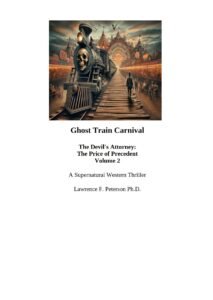
Ghost Train: Carnival
L.F. Peterson (C) Copyright 2026
“A Faustian legal thriller wrapped in supernatural horror — and it works brilliantly.”
—
Sam Quick killed twenty-three men in Redemption. Now he saves people for a living — specifically, people desperate enough to sign contracts with Hell itself. When a mother begs him to rescue her son from Eclipse Junction, a carnival existing outside normal geography where the Devil trades miracles for pieces of your soul, Sam returns to the one place no sane person visits twice.
But Lucifer doesn’t want Sam dead. He wants Sam employed.
Peterson has crafted something genuinely original here — a supernatural western where the gunfights happen in courtrooms and the bullets are legal arguments. The premise sounds almost absurd: a former gunslinger turned contract lawyer challenging the Devil’s fine print. Yet Peterson sells it completely, building a world where soul contracts operate with the mechanical precision of corporate law and the horror of eternal damnation hides behind professional courtesy and cream-colored parchment.
The novel’s real genius is its central trap. Every victory Sam wins strengthens Hell’s legal system. Every exploit he finds helps them close loopholes. Every principle of fairness he forces Lucifer to acknowledge makes the machinery of damnation more legitimate. Sam isn’t fighting the Devil, he’s refining him. And the deeper Sam descends into Eclipse Junction’s true operations, pavilions of extracted emotions, gardens of stolen names, vaults where existence itself writhes in glass containers, the more Peterson reveals the horror was never in the contracts. It was in what happens after you sign.
Dark, propulsive, and disturbingly thoughtful about the nature of consent, power, and the systems we build to justify taking from the desperate. You’ll never read the fine print the same way again.
—
Volume Two of the Ghost Train Carnival series
—
CHAPTER ONE: THREE WEEKS LATER
The Kansas City morning arrived with the particular quality of light making Sam Quick think of honest things: clean water, straight answers, and debts paid in full. He stood at his office window watching the street below come alive with commerce and conversation. People were moving through their lives carrying ordinary concerns about ordinary problems. A shopkeeper swept his stoop. A mother herded three children toward the schoolhouse with routine control. A delivery wagon rattled past loaded with crates of vegetables destined for the market on Fifth Street.
Normal. Unremarkable. Utterly real.
Sam was back from Eclipse Junction for three weeks. He found himself cataloging the ordinary world like a man recently returned from a foreign country. He needed to remind himself most of reality operated according to natural laws. Most transactions didn’t involve surrendering pieces of your soul. Most trains arrived at destinations appearing on actual maps.
He saved Mercy Kern. The little girl was healthy now. Her consumption cured by the carnival’s medicine. Her soul still her own because Sam found a way to exploit in her parents’ contract. A paradox clause voided agreements creating logical impossibilities. The Kerns signed away their daughter’s name, but they retained the right to call her by her name. The contradiction was enough. Management acknowledged the voidance and released the family from obligation. He let them walk away.
A victory. Clean and complete. The kind of win Sam was chasing since Redemption. The kind of win to help atone for the twenty-three people he killed. The kind of win to make his former violence mean something by saving lives instead of taking them. But the victory sat wrong in his gut. Like food appearing fine but tasting spoiled. Like a coin ringing false when you dropped it on the counter. Counterfeit.
Sam moved from the window to his desk. His notebook lay open to the page he was reviewing for the past hour. His handwriting covered the paper in neat, methodical lines, observations, questions, patterns he noted in the three weeks since returning from the carnival.
Observation One: The Kern contract contained the paradox clause deliberately. The language was too precise, too carefully constructed to be accidental. Someone wanted the vulnerability to exist.
Observation Two: The mysterious client, Robert Kern, spent two years in the carnival’s back lots before finding a loophole allowing him to hire me as an investigator. Two years is long enough to learn their system, to understand their methods, to know exactly what kind of exploit might work.
Observation Three: Management didn’t seem surprised when I invoked the paradox clause. He seemed… pleased. Like I did exactly what was expected.
Question: Was I supposed to win? Was the entire situation a test, to see if I could find exploits in their contracts? If so, why?
Sam turned these questions over in his mind for three weeks. He examined them from every angle, looking for explanations making sense. The carnival operated according to rules, twisted, supernatural rules, but rules nonetheless. They honored contracts. They acknowledged legitimate challenges. They played by their own laws even when those laws worked against them.
It didn’t mean they were stupid. It didn’t mean they made mistakes. It didn’t mean they left exploits in their contracts accidentally.
Management drafted soul contracts for millennia. Countless victims were collected and methods refined across centuries. Legal framework were designed for damnation operating with mechanical precision. A being so old, so experienced, so methodical didn’t make careless errors.
Which meant the paradox clause wasn’t an error. It was intentional.
But why? Why would the carnival deliberately include a vulnerability in their contracts? Why would they create a loophole allowing people to escape?
Sam considered theories. None of them were comforting.
A knock at the door interrupted his thoughts. Three sharp raps, confident and purposeful.
“Come in,” Sam called, his hand moving automatically to the Colt holstered at his hip. Old habits from his gunfighting days, when visitors arrived with violent intentions.
The door opened. A woman entered. She was perhaps thirty-five years old and well-dressed in a traveling suit of dark blue wool. Her face showed the kind of careful composure people developed when they learned to hide desperation behind professional courtesy. She carried a leather handbag and moved with the precise steps. She was undoubtedly someone who rehearsed this meeting in her mind. She was prepared what she was going to say. She steeled herself for a conversation she didn’t want to have.
“Mr. Quick?” Her voice was steady, but Sam heard the tremor underneath. Her fear was hard to control. “My name is Margaret Holloway. I was told you help people with… unusual problems.”
Sam gestured to the chair across from his desk. “Please, sit down. Who told you about me?”
Margaret sat, arranging her skirts with automatic precision, buying herself a moment to compose her thoughts. “Eliza Kern. She’s a friend of mine from church. She said you helped her family with a difficult situation. She said you were discreet, capable, and willing to investigate matters other people won’t touch.”
Sam nodded slowly. He asked the Kerns not to spread his name around. Not to advertise his services. Not to draw attention to the kind of work he did. But he understood why Eliza broke his request. When you were spared from Hell itself, when someone pulled your daughter back from damnation, you wanted to share the salvation with others. You wanted to give desperate people the same hope you were given.
“What’s your unusual problem, Mrs. Holloway?”
Margaret’s composure cracked slightly. Her hands tightened on her handbag. Her knuckles turned white. “My son is missing. My son, Thomas. He’s twenty-four years old. He works as a clerk for a shipping company. Three days ago he told me he was traveling to Denver on business. He packed a bag, kissed me goodbye, and left. He never arrived in Denver. The railroad has no record of his ticket. His employer says he requested time off for personal business, not company travel. I found this in his room.”
She reached into her handbag and pulled out a piece of paper, placing it on Sam’s desk with the careful precision of someone handling something contaminated.
Sam recognized it immediately. Cream-colored parchment, expensive quality, with text printed in beautiful script. Paper the carnival used for contracts.
He picked it up, his stomach tightening as he read:
MIDNIGHT EXPRESS
SPECIAL ACCOMMODATION
Passenger: Thomas Holloway
Destination: Eclipse Junction
Departure: Three days prior, 11:47 PM
Platform: The one that appears when needed
Fare: To be determined upon arrival
This ticket is non-transferable, non-refundable, and binding upon the passenger’s voluntary boarding. By accepting this ticket, the passenger acknowledges awareness of the destination’s nature and agrees to submit to all terms and conditions governing Eclipse Junction operations.
Sam set the ticket down carefully, his mind already working through implications. Thomas Holloway was being recruited. Someone from the carnival identified him as vulnerable. Someone researched his situation and offered him a ticket to Eclipse Junction. Thomas accepted, boarded the train, and traveled to the place where desperate people signd away pieces of themselves in exchange for solutions to impossible problems.
“Mrs. Holloway,” Sam said carefully, “what kind of trouble was Thomas in? What made him desperate enough to accept this ticket?”
Margaret’s face crumpled. The careful composure dissolved, revealing the fear and guilt underneath. “He had debts. Gambling debts. He played cards at establishments I didn’t know about. Places where the stakes were high and the people who ran them were dangerous. He owed money. A lot of money. More than he could possibly repay on a clerk’s salary.”
She pulled a handkerchief from her handbag, pressing it to her eyes. “I didn’t know how bad it was. Thomas kept it from me. He didn’t want me to worry. Two weeks ago, men came to our house. Rough men with hard faces. They asked for Thomas, said he owed them money. They said there would be consequences if he didn’t pay. I was terrified. I offered to help, to sell some of my late husband’s things, to find the money somehow. But Thomas refused. He said he’d handle it himself. He said he found a solution.”
“Three days later, he left for Denver.”
“Except he didn’t go to Denver. He went to Eclipse Junction. Mr. Quick, Eliza told me what the place is. She told me about the carnival, about the contracts, about what they do to people. If my son is there, did he sign something? Can you help him?”
Sam looked at the ticket again, at the beautiful terrible script, at the binding language acknowledging the destination’s nature. Thomas Holloway accepted this ticket voluntarily. He read the terms, or at least, he had the opportunity to read them. The carnival was meticulous about consent, about making sure people chose their damnation freely. The carnival ensured every signature was legitimate according to their twisted legal framework.
Which meant Thomas was in Eclipse Junction now. Likely meeting with one of the carnival’s contract administrators. Likely being offered a solution to his gambling debts in exchange for something he didn’t fully understand he was surrendering. Likely signing away pieces of himself, his time, his memories, his future, and his soul, because he was desperate and couldn’t see other options.
“I can try to help him,” Sam said. “But I need you to understand something, Mrs. Holloway. Eclipse Junction isn’t a normal place. It exists outside regular geography. It exists outside normal jurisdiction. The people who run it operate according to their own laws. If Thomas has already signed a contract, getting him free will be extremely difficult. Maybe impossible.”
“But you helped the Kerns. You saved their daughter.”
“I found an exploit in their contract. A vulnerability the carnival didn’t anticipate. But it doesn’t mean every contract has exploits. The carnival learns from their mistakes. They refine their methods. They close loopholes. The next contract might be airtight.”
Margaret leaned forward, her eyes desperate. “Please, Mr. Quick. Thomas is all I have left. His father died five years ago. My daughter died in childbirth three years ago. Thomas is my only family. I can’t lose him. I’ll pay whatever you ask. I’ll sell everything I own. Just please, help me get my son back.”
Sam looked at her face, at the desperation, the love and hope. He thought about Mercy Kern, healthy and whole. He thought about the twenty-three people he killed in Redemption and the violence he was trying to atone. He thought about the lives he needed to save to balance the scales.
He thought about the questions in his notebook, about the theories he was developing. He pondered the suspicion he was been tested, manipulated, used for purposes he didn’t fully understand.
And he thought about Lucifer’s smile, the way the ancient being looked at him with something like respect, the feeling Sam did exactly what was expected of him.
Taking this case meant going back to Eclipse Junction. Meant confronting the carnival again. Meant challenging their operations, finding exploits, forcing them to acknowledge vulnerabilities in their system. Or walking back into the trap.
He was potentially playing into their hands again, possibly serving purposes he couldn’t see. But it also meant helping Margaret Holloway. Meant trying to save Thomas. Meant fighting against the machinery grinding people down, converting desperation into damnation, transforming human weakness into eternal profit.
Sam Quick was never good at walking away from people who needed help. It wasn’t in his nature. It was why he survived Redemption when twenty-three others didn’t. It was why he spent five years running, looking for atonement, searching for ways to make the killing mean something.
“I’ll take the case,” Sam said. “But I need you to understand the risks. I might not be able to save Thomas. The carnival might have already collected what they wanted. Even if I succeed, there might be consequences. Things neither of us can anticipate.”
“I understand,” Margaret said. Sam doubted she really did. How could she? How could anyone.
“I’ll need information,” Sam said, turning to his notebook. “Everything you know about Thomas’s gambling debts. Who he owed money to. How much. When the men came to your house. Anything Thomas said about his ‘solution.’ Every detail matters.”
For the next hour, Margaret told him everything she knew. Thomas was gambling for six months, starting small but escalating quickly. He was in over his head at a place called the Silver Dollar, an establishment on the edge of the city where the games ran late and stakes ran high. He owed twenty-eight hundred dollars, a fortune for a clerk, an impossible sum to repay on his salary.
The men who come to the house two weeks prior worked for someone named Dalton. Margaret didn’t know Dalton’s first name. She didn’t know much about him except he ran the Silver Dollar with a reputation for collecting debts through whatever means necessary. Thomas was terrified after their visit. He locked himself in his room for hours, eventually emerging looking pale and shaken.
A week later, Thomas told Margaret he found a solution. He wouldn’t explain what it was, wouldn’t tell her the details, but seemed relieved. Almost euphoric. He said the debt would be handled, the dangerous men would leave them alone, and everything would be fine.
Three days ago, he’d left for “Denver.” He hasn’t been seen since.
Sam wrote it all down, his investigator’s mind cataloging details, looking for patterns, building a picture of Thomas Holloway’s desperation. The carnival undoubtedly identified him as vulnerable, a young man with impossible debts. They would know of the threats hanging over him and a mother he wanted to protect. They would surely have researched his situation, understood his pressure points, and positioned themselves as a solution at exactly the right moment.
It was the same pattern as the Kern case. The same methodology. Identify desperation, offer hope, extract consent, collect payment.
The carnival’s machinery operated with practiced efficiency.
“I’ll need a retainer,” Sam said when Margaret finished. “Fifty dollars to start. I’ll bill you for expenses as they occur for travel, research, or anything I need to investigate regarding Thomas’s situation. If I succeed in getting him back, we’ll settle on a final fee. If I fail…” He paused. “If I fail, you don’t owe me anything beyond the retainer and expenses.”
Margaret opened her handbag and counted out fifty dollars in bills. She placed them on Sam’s desk with shaking hands. “When will you start?”
“Immediately. I’ll need to make some preparations, gather some supplies, and review my notes from the last time I dealt with the carnival. Then I’ll find a way to Eclipse Junction and locate Thomas.”
“How do you get there? The ticket says ‘the platform appears when needed.’ What does it mean?”
Sam stood, moving to his filing cabinet, pulling out the folder containing everything he learned about Eclipse Junction during the Kern investigation. “The carnival exists outside normal geography. You can’t reach it by regular travel. You need an invitation, a ticket, a summons, a reason for them to let you in. Last time, I had a client who was there before, who knew how to find the platform. This time…”
He pulled out a business card from the folder. Cream-colored, expensive quality, with text printed in beautiful script:
ECLIPSE JUNCTION CARNIVAL & ASSOCIATED ENTERPRISES
For Inquiries, Disputes, or New Business
Present This Card at Any Railroad Platform After Midnight
We’ll Find You
Lucifer gave Sam the card after the Kern case. After acknowledging the contract’s voidance, and releasing the family. Sam took it without thinking much about it. He filed it away with his other case materials.
Now he understood it was an invitation. A way back. A method for returning to Eclipse Junction whenever he needed. Or when the carnival wanted him to return.
“I have a way in,” Sam said. “The carnival gave me a pass. It’s essentially a standing invitation to their operations. I can use it to reach Eclipse Junction, to find Thomas, and perhaps challenge whatever contract he’s signed.”
Margaret stood, her face showing relief mixed with lingering fear. “Thank you, Mr. Quick. Thank you for helping us. Thomas is a good boy. He made mistakes, but he doesn’t deserve… whatever they’re planning to do to him.”
“No one deserves what the carnival does,” Sam said. “It’s why I fight them.”
After Margaret left, Sam sat at his desk reviewing the information she provided. He methodically cross-referenced it with his notes from the Kern case. He looked for patterns, for connections, for anything to help him devise a strategy.
The gambling debts were new. The Kerns dealt with medical desperation, a dying child, a miracle cure, a contract signed in the panic of watching their daughter fade away. But the structure was identical. Identify vulnerability. Research the target. Position an agent at the moment of maximum desperation. Offer a solution. Extract consent. Collect payment.
Sam opened to a fresh page in his notebook and began writing:
The carnival operates systematically. They don’t collect souls randomly. They target specific people facing specific types of desperation. Medical crisis (Kern case). Financial crisis (Holloway case). Probably other types, romantic desperation, professional desperation, existential desperation. Each type requires different recruitment strategies, different contract structures, different payment terms.
Question: How do they identify targets? How do they know who’s vulnerable? How do they research people’s situations so thoroughly?
Theory: They have agents in the living world. People who work for them, who scout for vulnerable individuals, who report back to Eclipse Junction about potential recruits. These aren’t carnival employees traveling from Eclipse Junction. They’re human agents, living in our world, working for the carnival.
Which means the carnival’s operations are more extensive than realized. They’re not just a supernatural carnival existing in some pocket dimension. They’re an organization with infrastructure in the real world, with human collaborators, with a recruitment network spanning multiple cities.
Question: How many agents do they have? How widespread is their operation? How many people are being targeted right now, in Kansas City alone?
The implications were staggering. Sam thought of the carnival as a discrete threat, a supernatural entity you encountered if you were unlucky enough to find the Midnight Express. He presumed if you were desperate enough to accept a ticket you vulnerable enough to sign a contract. But if outside agents were actively recruiting, actively identifying targets, actively manufacturing opportunities for collection, then they were everywhere. Operating constantly. Grinding forward with mechanical efficiency. It all made sense.
How many people in Kansas City right now were being watched by carnival agents? How many desperate individuals were being researched, evaluated, prepared for recruitment? How many Thomas Holloways were out there, facing impossible situations, about to be offered solutions costing them everything?
Sam stood and moved to his window again, looking down at the street below. The shopkeeper was still sweeping his stoop. The mother and her children disappeared toward the schoolhouse. The delivery wagon moved on. Everything looked normal, ordinary, unremarkable.
But underneath the surface, the carnival’s machinery was grinding forward. Agents were watching. Targets were being identified. Contracts were being drafted.
Sam Quick was one man with a Colt revolver and a notebook full of questions. He was trying to fight an organization perfecting its methods for millennia.
The mathematics were brutal. But Sam was never been good at mathematics. He was always better at fighting.
He returned to his desk and began preparing for the journey to Eclipse Junction. He relied on his Colt, though he knew from experience it was useless against the carnival’s supernatural elements. He relied on his notebook, his case files, and his documentation from the Kern investigation. He needed the business card management gave him.
He needed to be ready for anything. Ready for the carnival to have anticipated his return. Ready for them to have prepared for his interference. Ready for the possibility saving Thomas Holloway would be harder than saving Mercy Kern. Contracts would undoubtedly be tighter and exploits fewer.
He needed to be ready for the likely possibility he was walking into another test, another manipulation, another situation designed to serve purposes he could not see.
He was compelled to go anyway. Because Margaret Holloway was desperate. Because Thomas was in danger. Because someone had to fight the carnival’s despicable machinery.
Because Sam Quick proved, again and again, he was willing to risk everything to save people from Hell itself.
It was what he did. Who he was. The only redemption he salvaged from Redemption.
Sam checked his Colt, loaded six rounds, holstered it at his hip. He gathered his materials, packed them in a leather satchel. He put on his coat, his hat, and prepared to leave.
It was three in the afternoon. Nine hours remained until midnight. Nine hours until he could use the business card to reach Eclipse Junction.
Nine hours to prepare for whatever the carnival had waiting for him.
Nine hours before Sam Quick returned to Hell.
END OF SAMPLE