
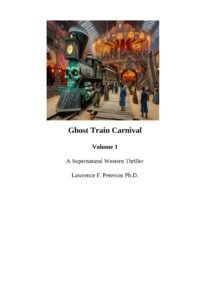
GHOST TRAIN CARNIVAL Volume One
Peterson has done it again. Writing a gripping supernatural Western where one man’s conscience becomes Hell’s greatest threat.
Sam Quick thought he left his gunfighting days behind. Five years of running from the ghosts of Redemption. Five years trying to atone for twenty-three deaths. But when a mysterious client hires him to investigate unusual disappearances on the Midnight Express, Sam boards a train refusing to follow normal tracks. It leads straight to Eclipse Junction, a supernatural carnival where souls are currency and desperation is the price of admission.
In this twilight realm between damnation and salvation, Sam discovers a system more terrifying than any outlaw gang: Hell operates on contracts, consent, and customer service. The carnival doesn’t force anyone to sign. It just makes sure the alternatives are worse. Vulnerable children are transformed into living advertisements. Memories are sold by the vial. The foreclosed work forever in the back lots, grinding out eternity one task at a time.
When young Mercy Kern’s life hangs in the balance, Sam faces an impossible choice: trade his soul to save her, or watch Hell’s machinery claim another innocent. But Sam Quick didn’t survive as a gunfighter by playing by other people’s rules. In a realm where violence is just another form of payment, and every transaction has hidden costs, he’ll have to outsmart the Devil himself or become exactly what Hell expects him to be.
A masterful blend of Western grit and supernatural horror, GHOST TRAIN CARNIVAL explores the price of redemption when the only currency accepted is pieces of your soul.
“Some debts can’t be paid with bullets. Some fights can’t be won with a gun. And some victories cost more than defeat ever could.”
—
CHAPTER 1: DUSK ON THE KANSAS PLATFORM
Kansas, 1885. The world at dusk was honest in the way only dying light could manage. Boards creaked under boot weight with the specific complaint of dry pine. Lanterns swayed on their iron hooks like pendulums counting down to something nobody could name. Men smelled precisely like what they were: sweat, horse, tobacco, and the particular sourness of bodies pushed through a day’s labor without mercy or pause. The wind came across the prairie with bluntness bordering on hostility. The dust was fine enough to work into the creases of a man’s hands and stay there like immortal stain.
Sam Quick arrived at the platform carrying competence the way other men carried pocket watches. Something checked frequently, wound tight, and never displayed unless absolutely necessary. He watched people the way a man watches a room for exits. He cataloged faces and postures with the automatic efficiency of someone who survived gunfire and never confused silence as safety. His coat hung open despite the evening chill. Not from carelessness but from a long enduring habit. A closed coat added half a second to a draw. Half a second was the difference between walking away and being carried away in a box.
His posture divulged someone who was shot and learned from it. Shoulders slightly forward, weight on the balls of his feet, and hands loose but never far from purpose. His face was weathered in the specific way of men who spent their youth outdoors and their nights indoors wondering if they’d see another morning. Crow’s feet sculpted the corners of his eyes, not from smiling but from squinting into sun and shadow, searching for motion where movement signaled danger. His hat was not a fashion statement. The overall style was rugged yet professional. The creased crown and leather band added character. It was the perfect disguise, helping an investigator remain inconspicuous.
The platform was crowded with the usual traffic of a rail stop at dusk. Farmers were heading home from the market. Salesmen congregated with sample cases worn at the corners. Women were dressed in traveling clothes, carefully clutching carpetbags. And children suffered boredom beside their parents, being restricted from wandering. Normal people doing normal things. Sam envied them in a distant, academic way. They moved through the world assuming it would sustain them. Sam stopped making such assumptions years ago.
He was here on a case. The case held a particular smell of something wrong from the beginning. Three weeks prior, a gentleman appeared at Sam’s office in Kansas City. The office was a single room above a dry goods store. The unsophisticated quarters was furnished with a desk scarred by cigarette burns and two chairs with uneven legs meant for business, not pleasure. A filing cabinet contained more empty space than files. The standard accouterments of his trade. A shingle hung outside: SAMUEL QUICK – PRIVATE INVESTIGATIONS – MISSING PERSONS, FRAUD, DISCREET INQUIRIES. The work came in irregular pulses. Sometimes three cases in a week. Sometimes nothing for a month. He took what came and tried to ignore the life he left behind.
The gentleman knocked precisely at two in the afternoon, the kind of knock suggesting both manners and urgency. Sam was reviewing notes on a warehouse theft. His coffee was cold from neglect when the knock came.
“Come in.”
The man entered dressed in black from collar to cuff, the kind of formal attire suggesting either a funeral or a profession requiring constant readiness for funerals. His coat was expensive but worn at the cuffs. His hat was brushed clean but showed the ghost of old sweat stains along the band. He moved with the careful deliberation of someone in pain. The pain was impossible to pinpoint. His face was pale, not from illness but from something deeper, the kind of existential exhaustion sleep couldn’t fix.
He removed his hat and held it against his chest like a shield. “Mr. Quick?”
“That’s right. Please, have a seat.”
The gentleman sat, placing his hat on his knee with the precision of a man who was taught manners young and never forgot. He looked at Sam with eyes carrying too much knowledge, too much weight, bereft of enough hope to balance the scales.
“My name is not important,” he said. “What is important is the work I need you to do.”
Sam leaned back in his chair. The wood creaked under his weight. “I don’t take anonymous clients. If I’m going to work for you, I need to know who you are.”
The gentleman’s mouth twitched in something almost resembling a smile. “A reasonable policy. Unfortunately, my situation won’t allow me to accommodate. I am bound by terms I cannot break. If I tell you my name, I forfeit my ability to help you. Helping you is the reason I am here.”
“Help me with what?”
“With staying alive. With staying human. With understanding the gravity of what you’re about to walk into.”
Sam studied him. The man’s hands trembled slightly where they gripped his hat. His breathing was shallow, controlled, like someone managing pain through sheer discipline. Whatever bound him was not metaphorical. It was acutely consequential.
“All right,” Sam said. “No name. But I need to know what you want investigated.”
The gentleman slowly reached into his coat and withdrew a leather portfolio. He carefully placed it on the desk between them. “The Midnight Express. It runs between Kansas City and Dodge City three times a week. Passengers frequently board and never arrive. Not dead. Simply gone. As if they stepped off the world’s edge.”
Sam opened the portfolio. Inside were newspaper clippings, ticket stubs, handwritten notes, and photographs. The documentation was meticulous. Dates, names, physical descriptions, and last known locations. Seventeen people went missing over the past six months. Men, women, and children. No pattern in age or occupation. The only commonality: they all boarded the Midnight Express, and none of them reached Dodge City.
“The railroad claims no knowledge,” the gentleman continued. “The conductors say the passengers disembarked at earlier stops. Families say their loved ones never sent word. The law investigated and found nothing. No bodies. No evidence of foul play. Just absence.”
Sam flipped through the documents, his investigator’s instincts cataloging details. “You’ve done thorough research.”
“I have reasons to be thorough.”
“What reasons?”
The gentleman’s hands tightened on his hat. “I can tell you this: the railroad is not what it appears. The conductor is not what he appears. If you board the midnight train, you will see things no living man should witness without consequences.”
“You’re asking me to investigate something supernatural.”
“I am asking you to investigate something real. Whether you call it supernatural or simply evil is your discretion. The result is the same: people are vanishing, and someone must stop it.”
Sam closed the portfolio. “Why me?”
“Because you are a man who has killed and regretted it. Because you are a man trying to build something legitimate from a foundation of violence. Because you understand guilt and are trying to escape it. These qualities make you… suitable.”
The word landed wrong, too specific, too knowing.
“Suitable? Suitable for what?”
The gentleman stood, placing an envelope on the desk. “Your retainer. Five hundred dollars now, five hundred upon completion. The next Midnight Express departs in three weeks. I wish I could tell you more but I have already said too much. I suggest you be on the train and see for yourself.”
He moved toward the door, then paused, his back to Sam. “One more thing, Mr. Quick. When you board the train, you will be offered things. Comfort. Forgetting. Relief. Do not accept any of these. Every transaction has a price. The price is always more than you think you’re paying.”
“Wait, “
But the gentleman was already gone. The door closed behind him with a soft click. Sam was left with the portfolio, the envelope, and the growing certainty he just accepted an assignment far more dangerous than the usual missing persons case.
Sam opened the envelope. Inside were ten fifty-dollar bills, crisp and new. There was also a single ticket for the Midnight Express departing Kansas City on October 23rd at 11:47 PM.
He spent the next three weeks researching. He visited families of the missing. He took detailed notes on their stories. A farmer’s daughter boarded the train to visit her sister and never arrived. A gambler vanished between stations. A widow traveling to Dodge City to live with her son was last seen boarding the train with a single trunk. The stories were consistent: normal people, normal reasons for travel, and then nothing. Something shady was obviously unfolding.
Sam visited the railroad office and spoke with clerks. They showed him ledgers proving the passengers purchased tickets. He spoke with conductors who swore they remembered nothing unusual. He examined the train itself during a daytime inspection. He found nothing out of the ordinary, just a standard passenger locomotive with coal car, baggage car, and three passenger cars.
Everything appeared legitimate. Which meant the problem was not in what he could see but what he couldn’t see.
Now, standing on the platform as dusk fading into night, Sam felt the weight of the case settling over him like a coat made of lead. The train waited on the tracks, black and gleaming. Lamplight caught brass fixtures in a way suggesting care and maintenance. Coal smoke drifted from the engine, mixing with the smell of oiled wood and something else. Sam detected a complex layered fragrance, like incense mixed with cotton candy and honey.
Other passengers gathered on the platform. Their faces showed the usual mixture of anticipation and fatigue common to travelers at the end of a long day. A woman in a nurse’s uniform stood with a small girl. The child’s face was pale and drawn. A man in a bowler hat clutched a leather satchel against his chest. A soldier in a faded uniform stared into nothing. His eyes carried the particular emptiness of someone who saw too much and could no longer unsee it. A gambler in a checkered vest shuffled cards with hands trembling slightly from nerves or drink. Sam couldn’t tell.
Sam moved among them, observing without appearing to notice. The nurse kept one hand on the child’s shoulder, protective and desperate in equal measure. The man in the bowler hat kept nervously checking his pocket watch, despite the train’s departure time being clearly posted. The soldier never blinked. His gaze remained transfixed on some imaginary distance only he could see.
These were people carrying weight. Sam recognized it because he carried his own.
A whistle blew, sharp and clear cutting through the damp evening air. The conductor appeared at the steps of the first passenger car. He wore an immaculate uniform and sported a black handlebar mustache. His smile suggested practice to the point of becoming stage performance.
“All aboard for Dodge City!” he called, his voice carrying across the platform with practiced cheerfulness. “Departure in five minutes! All aboard!”
Sam checked his pocket watch. 11:42 PM. Five minutes early. Rail schedules were approximate at best. He lifted his traveling bag, a single leather case containing a change of clothes and ammunition for his Colt revolver wrapped in oil cloth. He moved toward the train. The conductor stood beside the steps. He greeted each passenger with the same business like smile.
“Good evening, sir. Ticket, please.”
Sam handed over the ticket. The conductor examined it, his smile never wavering, then waved him on the train.
“Welcome aboard, Mr. Quick. Enjoy your journey.”
Sam paused. “I didn’t give you my name.”
The conductor’s smile deepened. “It’s printed on your ticket, sir. We like to provide personalized service.”
Sam glanced at the ticket stub in his hand. His name was indeed printed there, though he couldn’t recall seeing it before. The ink looked fresh, as if it appeared only moments ago.
—
END OF SAMPLE