
Science Fiction/Fantasy
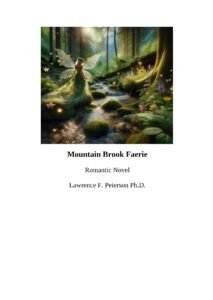
Mountain Brook Faerie
L F Peterson (C) Copyright 2026
A Luminous Tale of Love, Magic, and Environmental Stewardship
Mountain Brook Faerie is a deeply moving contemporary fantasy that reminds us what we risk losing when we forget to see the magic in the natural world.
Thomas Campbell arrives in the high country as a broken man, fleeing a failed marriage and a hollow career. What he finds is Brook—an ancient water faerie who has maintained her mountain spring for ten thousand years, now facing extinction from corporate mining interests. Their unlikely bond becomes the heart of a story that seamlessly weaves environmental activism with genuine magical realism.
Peterson’s greatest achievement is the authenticity of his central relationship. Brook is ancient, powerful, and profoundly lonely—the last of her kind in a world that has forgotten how to see her. Thomas’s decision to transform himself through the spring’s magic, extending his life to stay with her, carries real weight and consequence. Their love story unfolds with patience and emotional honesty, never rushed, always earned.
The novel’s environmental themes resonate powerfully without becoming preachy. The mining company’s threat serves as both plot driver and metaphor for humanity’s casual destruction of sacred places. Peterson shows us the exhausting work of protecting wild spaces—making Thomas’s victories feel hard-won and genuine.
Peterson’s prose is clean and evocative, particularly in his descriptions of the mountain landscape. The changing seasons become characters themselves, each bringing new challenges and beauty.
Mountain Brook Faerie will appeal to readers who loved The Night Circus, The Ocean at the End of the Lane, or Uprooted—stories where magic is real but fragile, where love requires sacrifice, and where the natural world holds consciousness we’ve forgotten to honor.
Deeply sincere, quietly powerful, and ultimately hopeful—a testament to the enduring magic of love and the wild places that still hold it.
“Peterson writes with earnest conviction about magic, love, and the importance of protecting sacred places.”
ACT ONE: AUTUMN – FIRST MEETINGS
Chapter 1: The Weight of Silence
Dawn crept over the eastern peaks like a hesitant animal, all caution and muted color. Thomas Campbell stood at the cabin’s single window. His coffee mug warmed his calloused hands. He watched light bleed across the ridge line. Six months elapsed since he walked away from everything, the practice, the house, the life he built and watched crumble like poorly mixed mortar.
The coffee was bitter. He ran out of sugar three weeks ago and kept forgetting to add it to his supply list. Maybe he didn’t forget. Maybe he preferred the bitterness now, the way it matched something fundamental inside him.
Behind him, Finn stirred on his bed of folded blankets near the wood stove. The border collie’s tags jingled as he stretched. He padded across the rough plank floor to press his nose against Thomas’s leg. The dog’s brown eyes held a question asked every morning: Are you okay?
Thomas reached down, scratching behind Finn’s ears. “Yeah, boy. I’m here.”
It was the best answer he could manage. Not okay, exactly. But here. Present. Breathing. Surviving.
The cabin smelled of wood smoke and coffee. Pine sap and mustiness was prevalent in a structure left empty for years before Thomas claimed it. He spent the past six months slowly bringing it back to life, patching the roof, replacing rotten floorboards, and re-chinking the log walls. The work was good. Physical. It required nothing of him except his hands and his back. Both of those he could give without thinking.
Thinking was the problem.
He moved to the stove and poured Finn’s kibble into a dented metal bowl. The dog ate with his usual efficiency while Thomas pulled on his boots. Heavy Danners he bought specifically for this new life when he thought the move was temporary. He told himself he just needed a year. Maybe two. He needed time to get his head straight. Then he would return to civilization.
Now, watching morning light transform the peaks from purple to gold, he wasn’t sure he would ever go back.
The cabin sat at eighty-five hundred feet elevation. It was high enough the air felt thin for the first month. It was high enough snow came early and stayed late. There were two cabins available when he contacted the Forest Service about their volunteer caretaker program. The lower cabin offered road access, solar panels, and a working well. Easy.
This one required a two-mile hike from the nearest trail head. It offered no electricity. Water was drawn from the brook running past it.
Thomas chose hard. He needed hard. Easy failed him.
He stepped onto the porch, Finn at his heels. The morning air bit his lungs. September in the high country. Autumn was already claiming the aspens. Their leaves shimmered gold against the dark green of spruce and fir. Somewhere a Clark’s nutcracker called, harsh and wild.
The brook sang its constant song twenty yards from the cabin. It tumbled down from the peaks in a series of small cascades. Thomas named it Whisperbrook within his first week here. He was charmed by the sibilant sound it made over smooth stones. The sound followed him into sleep, into dreams, and into long afternoons when he worked on the cabin and tried not to think about Sandy.
Sandy, who sat him down two years ago and said, “I can’t do this anymore.”
Sandy, who looked at him with something worse than anger. Pity.
“You’re not here, Tom. You haven’t been here for months. Maybe years. I need someone who’s present. Someone who isn’t just… going through the motions.”
He tried to argue. Tried to explain about the pressure at work, the big project, the partnership track. He tried to promise he would do better.
But she was right. He hadn’t been present. He was performing presence, going through the choreography of a life without actually living it. Somewhere in the middle of his explanation, watching her face, he realized he didn’t want to fight for it. The life they built felt like a costume he wore for so long he forgot it wasn’t real.
The divorce was civil. Painfully civil. They divided their possessions like business partners dissolving a company. She kept the house. He kept the truck and his architecture books. He kept Finn, the border collie puppy he found abandoned at a rest stop three years ago. He still recalled his oversized paws and desperate eyes.
“You should keep him,” Sandy said. “You actually love him.”
The implication hung between them: unlike me.
It wasn’t exactly true. He loved her. He just couldn’t be the person she needed. He was a driven man who showed up to the office and produced beautiful drawings of buildings he would never occupy.
So he relented. He sold most of his possessions and put the rest in storage. On a lark, he applied for the caretaker position. The Forest Service ranger warned him about the isolation, the difficulty, the long winters. Thomas simply nodded.
“Sounds perfect,” he said.
Now, six months in, he still wasn’t sure if he was running away or toward something. Maybe both. Maybe it no longer mattered.
Finn barked once, sharp, then sped off toward the tree line.
Thomas straightened, frowning. Finn’s behavior was odd, not his usual alert, purposeful run when he spotted a squirrel or deer. This was different. Slower. Almost reverent. His tail low and swaying gently.
“Finn! Here, boy!”
But Finn was already perched by the brook’s edge. He sat, perfectly still, staring at something Thomas could not see.
Thomas set his coffee mug on the porch railing and followed.
The morning light caught the spray where the brook tumbled over rocks. It created small rainbows in the mist. Beautiful. He never grew tired of this view. He never grew bored being somewhere untouched and wild. This was why he stayed, why he kept staying. The mountain asked nothing of him except respect and vigilance.
Finn remained motionless. His gaze was fixed on the water.
“What is it, boy? You see a trout?”
The dog’s tail wagged once, slowly. He didn’t look away from whatever held his attention.
Thomas moved closer, following Finn’s line of sight. Just water. Just light on water. Just, a shimmer.
He blinked and rubbed his eyes. The altitude sometimes plays tricks, especially in the early morning when the light is strange. But the shimmer remained, hovering in the spray like heat waves on summer pavement. The air was cold and the effect were localized, contained to one spot above the brook.
Thomas’s heart rate picked up. He thought he might be suffering from loneliness. Isolation did things to the mind. He read about it before coming here. He studied how solitude could create hallucinations. How the brain invented stimulation when deprived of input.
But Finn, the most practical, grounded creature Thomas ever knew, saw it too.
The shimmer intensified. Thomas felt the temperature change. Warmer. The air around him smelled something impossible. Wildflowers in September weeks past their bloom.
Then she stepped out of the water.
Thomas’s breath stopped.
She was small, no taller than Finn when he stood on his hind legs. Her form was composed of water and light. She was formed by the brook’s essence and shaped into a vaguely human figure. Her hair moved like current, green and silver, woven through moss. Her eyes were the deep amber of creek stones seen through clear water. When she moved, forget-me-nots and laurel flowers bloomed and faded in her footsteps, impossible and perfect.
Thomas’s axe, which he was carrying without thinking, slipped from his fingers and thudded on the soft earth.
The being, the woman, the creature, the whatever she was, tilted her head, studying him with an expression both ancient and curious. Her face held a terrible beauty, the kind found in natural things. It held the geometry of ice crystals, the spiral of a nautilus shell, and the branching of lightning.
Finn was still sitting at attention. He gave a soft whine.
The being’s gaze shifted to the dog. Her expression transformed. She smiled. When she smiled, the forest brightened. The light intensified. The flowers in her footsteps bloomed vibrantly. The brook’s song grew louder, more musical.
Thomas felt something complicated happen in his chest. Something not felt in years. Wonder, maybe. Or the beginning of belief in things beyond the concrete and measurable emphasized in architecture.
“Your companion has the old sight,” she said, reaching out a hand made of water held in the shape of fingers. Finn leaned forward, letting her touch his nose. Where her hand met his fur, tiny ripples spread outward. Finn’s solid form became liquid for a moment. “He knew I was watching.”
“Watching?” Thomas’s voice came out rough. He cleared his throat. “For how long?”
“Since you came to the mountain. Since you chose the cabin by my brook rather than the one by the dead lake below.” She withdrew her hand. Finn settled onto his belly. He seemed more content than Thomas witnessed in months. “Most humans choose the easier path. The lower cabin has a road. A truck can reach it.”
Thomas thought of the two-mile hike he made every time he needed supplies. The way he packed everything in on his back. Fifty-pound loads of food and propane and batteries. His shoulders ached just thinking about it.
“Well. I came up here to get away from easy.”
The being moved closer. She was perhaps four feet tall. Her form constantly shifted, unable to maintain complete solidity. Up close, he could see she wasn’t exactly translucent. She was made of the same substance as the brook, given temporary shape and purpose.
She studied him the way he might study a new trail, trying to determine if it was safe to follow.
“You are running,” she said.
Not a question. A statement.
Thomas’s jaw tightened. “Maybe.”
“From what?”
He looked away, toward the cabin he was slowly repairing. Six months of work, and it still needed so much. New windows. Better insulation. A proper foundation under the northwest corner where the ground settled.
“Noise,” he said finally. “People. Expectations. A life I couldn’t…” He paused, searching for the right word. “A life I couldn’t fit into anymore.”
He didn’t mention Sandy. He didn’t mention the divorce, the failure, the way he looked at his reflection one morning and failed to recognize the man staring back. Some things were too raw to speak aloud, even to a hallucination.
Especially to a hallucination.
The being was quiet for a long moment. When Thomas finally looked back, he found her gazing at the brook with an expression he recognized. The look of someone who understood loss intimately.
“Once, there were many of us in these mountains. Brook faeries, stone singers, and wind weavers. But the world grew loud and rushed. My kin faded or fled to deeper places.” She turned her amber eyes back to Thomas and he saw centuries in them. Millennia, maybe. “I remained because this is my brook. My responsibility. Even if I am the last to remember it.”
Something in Thomas’s chest loosened. A tension he carried for so long he forgot it was there.
“So we are both stubborn, then.”
Her laugh was like water chiming over rocks, clear and bright and utterly inhuman. “Perhaps.”
They stood in silence, man and faerie and dog, while the brook sang around them and the morning light turned the peaks to fire.
Finally, Thomas said, “I’m Thomas.”
“I know. I have heard you speak it to your companion.” She gestured at Finn, who thumped his tail once against the ground. “I am…” She made a sound like water flowing over particular stones, a pattern of current and splash Thomas knew immediately he could never reproduce.
He tried anyway, and the result was so mangled the faerie’s eyes widened.
“An admirable attempt,” she said diplomatically.
“I’m going to need something I can actually pronounce.”
She considered this, her form rippling slightly. “You may call me Brook. It is close enough to my nature.”
“Brook.” Thomas tested the name. “A little on the nose, isn’t it?”
“And Thomas means ‘twin.'” Her lips curved in something like amusement. “Yet I see no second of you.”
Despite everything, the impossibility, the strangeness, the fact he was having a conversation with a water hallucination, Thomas felt himself smile. A real smile for the first time in months.
“Touché.”
Brook’s form brightened again. Thomas realized her appearance reflected her emotions. When she was pleased, she grew more luminous. When sad, she dimmed.
“I should return,” she said, glancing at the brook. “The water calls me. But…” She hesitated, and Thomas saw uncertainty cross her face. “I would speak with you again. If you are willing.”
“I’m willing.” The words came out faster than he intended, almost eager. He cleared his throat. “I mean, If you want.”
“Tomorrow, then. When the sun reaches the tall pine.” She pointed to a massive ponderosa on the far bank.
“Tomorrow,” Thomas agreed.
Brook smiled once more, the forest-brightening smile, and then she simply… dissolved. One moment she stood before him, solid and present. The next, she was water, flowing back into the brook as if never separate from it.
Thomas stood frozen, staring at the spot where she materialized.
Finn rose, shook himself, and trotted back toward the cabin as if nothing unusual happened.
“Right,” Thomas said to the empty air. “Just another morning in the mountains.”
His hands were shaking as he picked up his axe. His heart was pounding as he walked back to the cabin. He poured himself another cup of coffee and sat on the porch. He focused on the brook, waiting to see if she would reappear.
She didn’t.
By noon, he half-convinced himself he imagined the whole thing. Altitude sickness. Loneliness. The mind playing tricks. There must to be a rational explanation. But Finn kept glancing at the brook, his tail wagging slightly. Flowers were growing where none grew before. Forget-me-nots and mountain laurel, blooming impossibly in the September cold.
Thomas touched one of the flowers. It was real. Solid. Cool under his fingers.
“Tomorrow,” he said to Finn. “We’ll come back tomorrow. See if she’s real.”
The dog barked once, as if in agreement.
Thomas spent the rest of the day working on the cabin’s roof, replacing shingles damaged by last winter’s storms. Physical work. Concrete work. The kind of work where you could see the results of your labor.
His mind kept drifting to the brook, to amber eyes and water-shaped hands, to a voice like current over stone.
It was the first truly interesting event he encountered in years.
—
Chapter 2: The Fallen Birch
The storm came later, rolling down from the peaks with the kind of violence only high country weather could muster. Thomas woke to thunder shaking the cabin’s frame and rain hammering the roof like fists demanding entry. Wind screamed through the pines, and somewhere in the darkness, something large crashed to the ground.
He lay in his sleeping bag, listening. Finn pressed against his side, warm and solid. The dog wasn’t afraid of storms, he weathered plenty in his three years, but he was alert, ears pricked, tracking each sound.
“Just wind,” Thomas murmured, more to himself than the dog.
But he didn’t sleep again. He lay awake, counting the seconds between lightning and thunder, calculating the storm’s distance and trajectory. Moving closer. Then overhead. Then, finally, moving away toward the eastern valleys.
By dawn, the storm passed, leaving the world scrubbed clean and dripping.
Thomas made coffee and stepped onto the porch. The air smelled of ozone and wet pine, sharp and electric. Water dripped from every surface. The brook’s song changed, louder, more urgent, swollen with runoff.
Finn bounded down the steps and immediately headed for the tree line. His nose was near the ground, tracking scents the storm redistributed.
Thomas followed more slowly, coffee in hand, surveying the damage. A few branches down. Nothing major. The cabin weathered worse. He reinforced the roof himself, and his work held.
When he reached the brook and stopped.
A birch tree, maybe thirty feet tall, white bark gleaming in the morning light, fell across the water. Not broken, but uprooted, the storm’s wind finally defeated the roots weakened by last year’s drought. The tree lay at an angle, its crown on the far bank, its root ball still clinging to a mass of earth on the near side.
The brook flowed around and under it. Already Thomas could see the water backing up, pooling, beginning to redirect. Give it a few days and the brook would carve a new channel. Give it a few weeks and the tree would dam the flow entirely, creating a pond where none should exist.
END OF SAMPLE