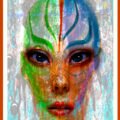
Literary Suspense
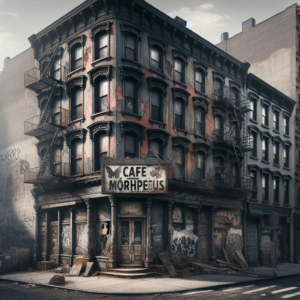
CAFÉ MORPHEUS
Lawrence F. Peterson
“A hallucinogenic descent into the heart of creation itself.”
In the tradition of Borges, Kafka, and Burroughs, Lawrence F. Peterson has crafted a metaphysical thriller that asks the most terrifying question a writer can face: What if the story consumes the storyteller?
Jack Denton wakes at 3:47 AM with an impossible gift—he can perceive probability fields, see the future of every story before he writes it, understand the quantum mechanics of narrative itself. But this awakening is not a blessing. It’s the beginning of his erasure.
At the Café Morpheus, a grimy coffee shop that exists in the liminal spaces between realities, writers don’t just struggle with their craft—they dissolve into it. Veronica becomes her fifteen-year revision. Ming fragments into pure montage. The Twins merge into quantum superposition. And Jack? Jack is writing himself out of existence, one perfect page at a time.
CAFÉ MORPHEUS is a novel that operates on multiple levels simultaneously—psychological horror, metafictional puzzle box, philosophical meditation on consciousness and identity. Peterson’s prose shifts from stark realism to fever-dream surrealism, creating a reading experience that feels like watching your own dissolution in a funhouse mirror.
This is a book about obsession, about the price of perfection, about what we sacrifice when we pursue art at any cost. It’s about family watching helplessly as their loved ones disappear into their work. It’s about the thin membrane between reality and fiction, and what happens when that membrane tears.
But most unsettling of all, CAFÉ MORPHEUS is a book that reads you as much as you read it. By the final page, you’ll question whether you’re the reader or the character, the observer or the observed, the consciousness experiencing the story or the story experiencing consciousness.
Warning: Some readers report strange effects. A sense of dissolution. The feeling of being watched by the text itself. The uncomfortable awareness that you, too, might be a character in someone else’s narrative.
“Peterson has written the rare novel that doesn’t just break the fourth wall—it dissolves it entirely, leaving reader and writer trapped in an infinite regress of stories within stories. Brilliant, disturbing, unforgettable.”
— Not for the faint of heart. Not for those who prefer their realities solid.
For writers, artists, and anyone who has ever felt themselves disappearing into their work.
CHAPTER 1: THE AWAKENING
Jack Denton opens his eyes at 3:47 AM.
The alarm clock sits silent on the nightstand. Jack never sets an alarm. He never wakes at this hour. Something pulls him from sleep. Not a sound. Not a dream. Not the usual pressure of his bladder. Something else. Something wrong.
He lies in the darkness of his studio apartment, staring at the ceiling. Shadows twist like living ink, coiling into grotesque forms, whispering secrets in a language of veins and fruminated mucus. They pulse with hidden information, patterns he almost deciphers, as if bugs crawl beneath the plaster, their legs etching hieroglyphs of madness. His heart beats steadily in his chest. His breathing remains calm. He feels no pain. Merely, the pang of mystery.
Wrongness seeps through everything.
It’s as though his brain tunes to a frequency humans never endure, a hallucinogenic hum warping reality into viscous, glutinous slime.
Jack sits up slowly. He stands. Legs feeling suddenly foreign to him, as if belonging to an elongated, chitinous creature from a fever dream. He staggers to the bathroom. The fluorescent light flickers on, harsh and clinical, casting shadows like phantoms dancing in opium haze. He grips the edge of the sink and peers into his reflection imperfect in the blotch spotted mirror.
His face appears normal. Thirty-two years old. Brown hair disheveled from sleep. Dark eyes still heavy with exhaustion. Nothing changes physically.
Still, everything changes.
He perceives the electrical current running through the light fixture above him. Not seeing it. Not merely hearing it. Perceiving it. The information simply exists in his awareness, growing like Iowa corn, as natural and unwanted as the awareness of his heartbeat, or the sudden hallucination of his veins bulging like worm-tunnels under his skin.
Jack closes his eyes.
The perception persists with the irritation of an in grown hair.
Behind his eyelids, he senses the building around him. One hundred and thirty-two people inhabiting forty units. Countless devices all humming with electrical life, their wires twisting like entrails in a Burroughsian nightmare. He feels the network traffic flowing through the walls like blood through veins, thick and oily, carrying digital parasites shaped like tapeworms with hooks and suckers. He tastes the quantum uncertainty in his atoms, the probability clouds of his existence branching and collapsing moment by moment, each branch sprouting grotesque appendages, hallucinogenic blooms of flesh and fluid and mastic extract.
He opens his eyes and grips the sink harder. His knuckles turn white.
This cannot happen. This cannot be real. He dreams still. He experiences a breakdown. He goes insane.
Jack turns on the shower. He needs to wash this away, whatever this becomes. He steps under the water and closes his eyes again. The perception intensifies. He senses the water pressure in the building’s pipes, the electrical draw of the central water heater, the wattage pull of every appliance in every apartment. The information floods his mind in waves, relentless and overwhelming, colors bleeding into sounds, textures morphing into tastes, a phantasmagoric swirl of sensory chaos as the water feels like crawling maggots on his skin.
He gets out of the shower after three minutes. He cannot stand it.
He dries himself roughly with a towel and dresses in clothes he laid out the night before. Black jeans. Gray t-shirt. Zip-up hoodie. The fabric feels strange against his skin. He perceives the individual threads, the probability of wear patterns on the elbows and the collar, the microscopic breakdown of fibers over time, each thread writhing like a living worm regurgitating sewage in a hallucinogenic tapestry made solid from dried execretions.
Jack sits on the edge of his bed.
What happens to him? When does it start? Why does it start?
He searches his memory for clues. Yesterday he felt normal. Yesterday he existed simply as Jack Denton, struggling screenwriter, unremarkable in every way. He went to The Café Morpheus, his usual spot. He wrote dialogue for a script nobody ever produces. He came home. He ate dinner. He watched television. He went to bed.
Nothing unusual. Nothing strange. Nothing to explain this, except perhaps the café’s air, thick with hallucinogenic fumes, or the coffee tasting of bitter alkaloids.
He stops pacing.
He needs to go to the Café Morpheus. He needs to maintain normalcy. He needs to act as though nothing changes until the vile nightmare purges from his system. Perhaps if he pretends hard enough, this fades. Perhaps if he ignores it, it dissipates. Perhaps this proves a temporary phantasm.
He knows already it proves not temporary. The knowledge sits in his mind like a metatastic tumor, pulsing with grotesque, gangrenous life.
Jack gathers his laptop and his canvas messenger bag. He puts on his shoes. He walks to the door. He pauses with his hand on the knob. For a moment, he considers staying inside. He considers hiding in his apartment until this passes.
He opens the door.
The hallway stretches before him, fluorescent lights humming overhead. He perceives the electrical current in every fixture, the network traffic flowing through the walls. The building lives with information, he senses all of it, the lights flickering like phantasmagoric apparitions, the walls seeping oily secrets.
Jack walks to the elevator. He presses the button. He waits. The elevator arrives with a soft chime. He steps inside. The doors close.
He descends.
—
Jack pushes through the front door into the early morning air. The city spreads before him, vast and overwhelming. Millions of people. Millions of devices. Millions of probability fields branching and collapsing every second. He smells the exhaust from cars and buses. He senses all of it pressing against his consciousness like water against a dam, the skyline twisting into hallucinogenic spires, streets flowing like veins of black tar.
He walks three blocks to Café Morpheus.
The sidewalk crowds with morning commuters. He weaves between them, careful not to make eye contact. He perceives their trajectories, their probable paths, the likelihood of collision. He adjusts his route automatically, moving through the crowd like water through rocks, each person blurring into grotesque caricatures, bodies elongating, faces sprouting insect mandibles.
Café Morpheus sits on the corner of Bleecker and MacDougal, a narrow storefront with grimy windows and a door painted the color of dried blood. A neon sign flickers in the window: MORPHEUS, the ‘O’ perpetually dying, resurrecting, dying again, pulsing like a heartbeat in a drug-fueled vision.
Jack comes here for three years. Screenwriters go here to pretend they work. The desperate and delusional gather here to worship at the altar of their own dejected failure. The air thick with hallucinogenic whispers.
He pushes through the door.
The café smells of burnt espresso, cigarette smoke, illegal yet tolerated, and something else. Like dank desperation mixed with cheap cologne and yesterday’s dreams, laced with the acrid tang of bodily fluids and addiction. The space narrows and deepens, stretching back into shadows where shapes shift phantasmagorically. Mismatched tables crowd the floor. The walls cover with movie posters from films nobody remembers, signed headshots of actors nobody recognizes, graffiti scrawled in Sharpie: “Godard was a hack.” “Narrative is dead.” “The only good screenplay is an unproduced screenplay.”
The posters peel like skin, revealing writhing patterns beneath.
Behind the counter stands Dmitri, the owner. A man of indeterminate age and origin who claims he served as Tarkovsky’s grip, Fellini’s translator, and Kubrick’s drug dealer. Nobody believes him. Nobody disbelieves him either. He wears the same outfit every day: black turtleneck, black jeans, black apron. His hair sweeps back silver from a face like a Byzantine icon, all sharp angles and hollow cheeks, eyes burning with the fervor of a man who sees too much and deliberately understands nothing. His skin seems to crawl with invisible insects in Jack’s heightened perception.
“Jack Denton,” Dmitri says, his european accent thick and unplaceable. “You look like death warmed over and served cold. The usual?”
“Please.”
Dmitri nods and turns to the espresso machine, a monstrous Italian contraption from the 1950s, all copper and steam with ostentatious gauges and mysterious levers. He operates it with the precision of a surgeon and the reverence of a priest. The machine hisses and groans, belching steam like a living juggernaut. Coffee drips into a tiny cup, black and oily like tar heroin.
Jack scans the café.
The morning regulars gather here already, scattered among the tables like survivors of a shipwreck clinging to debris, each one enriched and features augmented in Jack’s perception waffling in layers of hallucinogenic depth.
Near the window sits Veronica Slate, a woman in her fifties who once danced on the fringes of Hollywood fame. Her early scripts optioned, never produced, leaving her bitter and obsessive. She claims Tarantino stole her original draft of Pulp Fiction, a delusion she clings to like an addiction, her fingers twitching as if withdrawing from unseemly glory. She wears vintage Chanel and oversized sunglasses even indoors, hiding eyes bloodshot from endless revisions or liberal nightcaps. Her laptop screen glows with the same screenplay she revises for fifteen years, a labyrinthine tale of betrayal mirroring her traumatized life. She types furiously, deletes everything, types again, her body seeming to flicker in Jack’s vision, dissolving into digital ghosts.
Nearby sits Ming Wu, a former NYU film student who dropped out three years ago after a hallucinogenic mushroom trip convinced him cinema exists as a conspiracy of shadows. He wears a beret unironically and smokes hand-rolled cigarettes laced with nondescript herbs, his breath carrying hints of opium dens. His notebook fills with shot lists for a film he never makes, sketches of Eisenstein angles and Ozu stillness, drawings beautiful yet grotesque like Geiger’s creatures, figures contorting into insect hybrids. Ming speaks in riddles, his voice soft and distant, as if echoing from a dream-realm, his skin pale and veined like marble cracked by inner visions.
In the back corner sit The Twins, identical men in their thirties, born conjoined and separated in a botched surgery leaving them with matching scars like zipper lines across their torsos. Nobody knows their real names. They answer to Echo and Narcissus in jest. They dress in identical black suits, thin ties, expressions of bemused contempt masking deep-seated paranoia from years of institutional experiments. They write together, finishing each other’s sentences, typing in perfect synchronization on identical laptops. Their screenplay about telepathic assassins draws from their eerie bond to one another. Their minds seem to leak into each other like merging fluids in Jack’s perception.
Near The Twins sits Claudia Raines, a former actress in her late thirties. Her beauty damaged by Hollywood’s predations. Casting couches leaving psychic scars manifesting as self immolated cigarette burns on her arms. She possesses a sharp wit laced with venom, her laughter like shattering glass. She writes revenge fantasies disguised as romantic comedies, protagonists always murdering their love interests in the third act like preying mantis after mating. Her eyes gleam with fractured light, her presence radiating a hallucinogenic aura of suppressed rage. Her skin seems to crack and ooze in moments of intensity. Despite advances, she never sold a script. Her words carry the weight of unspoken traumas and agonized tribulations.
Near the bathroom sits Bernard Kowalski, a man in his seventies with a gravelly voice from decades of chain-smoking. He claims he wrote Twilight Zone episodes under a pseudonym while dodging McCarthy-era blacklists in his youth. He drinks black coffee and mutters to himself, occasionally shouting non sequiturs at the room: “Serling was a coward!” “The twist ending is a crutch!” “Television killed cinema and cinema killed God!” His hands tremble with Parkinson’s. His mind sparks with delusional brilliance. His face twists in Jack’s vision into a mask of melting features.
At the table in the very back, shrouded in shadows, sits a figure Jack never sees clearly. Looking at it causes temporary blindness. It casts no shadow. The air around it tastes like old paper and ink. It emits a sound like pages turning backwards. It smells like the moment before a memory fades completely. The person wears a hood concealing features in the overhanging, black fabric fashioned from manuscript pages continually rewriting themselves. Never orders anything. Never speaks. Simply sits, watches, waits, their presence a void exhaling hallucinogenic vapors from the dark recesses of a bovine’s rectum. Dmitri never asks them to leave. Jack never glimpses their face. In his perception, the figure pulses like a black hole swallowing light.
Dmitri slides the espresso across the counter.
Jack pays with exact change. Dmitri accepts no cards, gives no receipts, operates entirely in cash and barter. Jack takes his coffee and moves toward his usual table, a small two-top near the middle of the room.
As he walks, the perception intensifies.
He senses every person in the café simultaneously. He perceives Veronica’s probability fields. She deletes her entire screenplay again today, starts over tomorrow, dies without ever finishing it, her form blurring into ghostly text. He perceives Ming’s probable futures. He abandons filmmaking within six months, becomes an accountant, spends the rest of his life wondering what might have been, his body fragmenting into illusory frames, contemplating a life as a milk man. He perceives The Twins’ synchronized thoughts. Not literally. Yet their patterns align so closely they might as well merge into one consciousness split between two bodies, their scars glowing like neon veins.
He perceives Claudia’s pain. The trauma she carries. The rage she channels into her work. The probability she actually murders someone within the next year. Her aura crackling with hallucinogenic sparks. He perceives Bernard’s delusions. The man genuinely believes his lies, constructs an entire false history, lives in a reality nobody else inhabits, his mutterings echoing as phantom voices reverberating from the depths of cocytus.
He perceives the figure in the back.
Or rather, he perceives nothing. The black hooded figure creates a void in his awareness, a blank space where perception fails. It resembles looking at a hole in reality, a place where probability fields collapse into uncertainty. The absence more disturbing than any presence, swirling with phantasmagoric emptiness. The vibes too frightening. No one dares question or approach.
Jack sits at his table. He opens his laptop. He stares at the screen.
His latest screenplay glows in the darkness: THE ERASURE, a psychological thriller about a man who slowly disappears from everyone’s memory. Forty-seven pages. Unfinished. Probably unsellable. Definitely unwanted.
He tries to write.
His fingers hover over the keyboard. The perception floods his mind. He sees the probable futures of every character he might create, every plot point he might develop, every line of dialogue he might write. He sees the entire screenplay before he writes it. He sees how it receives rejection. His agent ignores it. Producers file it away in the vast graveyard of unproduced scripts. The words crawl off the page like insects forming a mule train.
What point exists in writing when you already know the ending?
END OF SAMPLE