Psychology
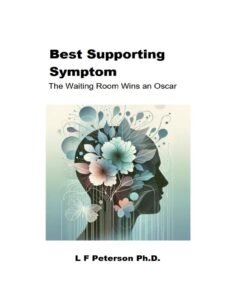
BEST SUPPORTING SYMPTOM
The Waiting Room Wins an Oscar
L F Peterson Ph.D.
Genre Mash: Satirical Psychodrama / Meta-Comedy / Therapeutic Ensemble Piece / Award-Show Neurosis Fable
Verdict (front-loaded for the impatient): 5 glitter-resistant stars out of 5. Read it before it inevitably gets misinterpreted by a think‑piece about “performative wellness.”
Review:
If you’ve ever suspected that modern therapy culture contains equal parts earnest healing, dramaturgical improvisation, laboring defense mechanisms, and a quiet, frightened plant in the corner Best Supporting Symptom weaponizes that intuition into narrative art. Dr. L. F. Peterson (via the irrepressibly theatrical Dr. Felix Peterson) has written (or staged) a book that feels like if Community, Severance, and a supervision group transcript were fed through a sly Jungian meme generator and then line-edited by someone with a Ph.D., restraint issues, and a humane streak a mile deep.
Premise & Frame:
The conceit is audacious: a therapy studio that treats symptoms like unionized ensemble actors. There’s a literal in-house “award season” every morning, laminated defense mechanism role sheets, a therapy dog named Carl Bark cycling archetypal capes, and a self-aware clinician who must constantly audit his own flair before it hardens into avoidance. Into this semi-ritualized psychotheater walks Iris the avatar of absence, a sovereign void that refuses to play along. Her arrival tilts the tonal register from dazzling satire toward quietly destabilizing authenticity. Watching the book pivot without dropping its humor contract is thrilling.
Voice & Style:
Every paragraph crackles with layered wit: clinical vocabulary waltzes with stage directions; jokes arrive meta-tagged with their own built-in ethical disclaimers; and silence weaponized as character often “wins” scenes over punchlines. The prose trusts the reader to hold irony and sincerity at once (a rarity). The narrative pacing alternates quick, staccato comedic volleys with elongated beats of negative space especially in Iris’s first session giving emotional afterimages time to bloom. That structural modulation becomes a thematic argument: restraint amplifies meaning.
Characters (Ensemble Excellence):
– Dr. Felix Peterson: A ringmaster battling caricature creep; he’s a fascinating study in ethical flamboyance.
– Mara (“Marvel”): Administrative hyper-structure as attachment strategy played for humor but rendered with compassion.
– Lionel & his “Intimacy Hiccups”: A brilliantly absurd somatic tic that evolves into a punctuation philosophy.
– Bee: Archivist of everything, her whispering grief edging toward audibility. Maybe the quiet heart.
– Iris: Negative space incarnate she arrives like a solvent, dissolving performative lacquer. Her “baseline of authentic nothing” reframes the book midstream.
– Trent, Zoya, Omar, Dahlia, Harold, Sylvia: Each a facet of contemporary coping content addiction, narrative staging of phobia, perfectionistic revision, numerological compulsion, meteorological affect, and compliance-as-identity.
– Defense Mechanisms themselves (via union minutes & grievance sketches): A genius meta-layer anthropomorphized but not trivialized.
Thematic Richness:
1. Performance vs. Presence: The book interrogates how quickly help-seeking mutates into aestheticized suffering and how to rescue sincerity without scorning imaginative ritual.
2. Labor Politics of the Psyche: The “Defense Mechanism Union” isn’t just a running gag; it reframes coping as labor requiring rest cycles and humane contracts.
3. Absence & Desire: Iris’s refusal to manifest a symptom dramatizes anhedonia and existential flatness with rare nuance inviting spaciousness rather than pathologizing void.
4. Ritual as Scalpel & Shield: The awards, props, laminated cards tools that can tip into decorative dissociation. The text repeatedly audits itself in-scene.
5. Ethical Showmanship: Felix’s inner Manifesto drafts serve as guardrails; they model reflective practice for a culture obsessed with “relatability.”
Structural Innovation:
The interleaving of:
– Script fragments
– Union minutes
– Mini-manifestos
– Staged “interludes” (Humor filing grievances)
…creates a polyphonic dossier of a treatment ecology. It reads like a qualitative study that escaped peer review to chase a Fringe Festival slot yet it’s more clinically literate than many earnest texts.
Humor (and its Restraint):
The comedy never punches down; the laugh lines are self-reflexive diagnostics. Crucially, the narrative demonstrates the discipline of withholding humor at pivotal grief-adjacent junctures (Bee’s whisper scene; Iris Session One) thus earning trust.
Comparative Touchstones:
– Think Lisa Kron’s meta-theatrical intelligence meets Nick Hornby’s character cadence, with shades of Bo Burnham’s self-surveilling humor ethic.
– Fans of Michaela Coel’s tonal bravery or Jenny Offill’s fragmentary emotional architecture will appreciate the negative space technique.
– For therapists: feels like Irvin Yalom got dramaturgically coached by Phoebe Waller-Bridge.
Potential (Minor) Areas for Refinement (offered lovingly):
– Risk of Over-Saturation: Some early sequences stack high-concept jokes so densely that first-time readers may skim; a few micro-breaths earlier could help non-clinicians savor subtext.
– Iris Integration Pace: Her silence is powerful; a touch more internal phenomenology (without betraying her void integrity) might accelerate broader emotional attachment.
– Accessibility Layer: A glossary-lite aside (in-universe, perhaps as a DMU pamphlet) could widen entry for readers not already fluent in defense mechanism taxonomy.
Emotional Resonance & Impact:
Unexpectedly moving. The pivot from flamboyant psychodrama to earnest micro-shifts (e.g., Bee wanting “not to whisper,” Omar’s first-draft acceptance) hits harder because the book earns pathos through disciplined comedic restraint. That final image of a leaf and an unoccupied performative impulse? Haunting in the best way.
Who Should Read:
– Therapists seeking an antidote to burnout via imaginative reframing.
– Neurodivergent and anxiety-spectrum readers tired of pathologizing prose.
– Creatives fascinated by how form can mirror psychic process.
– Anyone allergic to saccharine “healing journeys” but still craving transformation narratives.
Re-Read Value:
High. Margins beg for annotations (ironically mirroring Bee’s archiving impulse). Subtle foreshadowing (Trent’s latent virality gambit) promises future ethical complications sequel hunger activated.
Final Applause:
Inventive, compassionate, sharply funny, self-vigilant. It somehow critiques performative vulnerability while modeling healthier versions of it. If Act One (what we have) is this textured, the subsequent arcs (external evaluation pressure, Iris’s slow thaw, the ethics of algorithmic exposure) could build a genuinely original therapeutic saga.
Rating:
5/5 – Winner: Best Ensemble Neuron. Also wins a special citation for Ethical Use of Props.
Recommendation Protocol:
Clear your evening. Read with a cup of unpretentious tea. When you laugh (you will), notice which defense mechanism perks up. When you reach Iris, let the quiet do its recalibrating work.
Curtain (Half-Lowered). Awaiting Act Two.
CHAPTER 1: THE MORNING NOMINATIONS
Dr. Felix Peterson polished the bronze statuette the way a sommelier inhales legend by applying two brisk circular buffs and a flourish suggesting reverence without religion. The statuette, a theatrical mask kissing a miniature brain, displayed a fresh lipstick smudge on its right hemisphere. Somewhere, an archetypal urge clearly made out with neurology.
“Marvel!” he called.
Mara “Marvel” Klein slid in sideways clutching three clipboards, a hex-color swatch fan, and coffee in a conical Erlenmeyer flask. Her smile was as bright and rigid as a safety brochure. “We’re five minutes behind the aspirational schedule but three minutes ahead of the realistic panic.”
“Excellent,” Peterson said. “Set the Casting Call.”
Mara flipped the whiteboard: CASTING CALL – TODAY’S NOMINATED SYMPTOMS. She wrote, in progressively more theatrical fonts:
1. Lionel’s Intimacy Hiccups (returning champion)
2. Zoya’s Edible Escalator (two-tier prototype)
3. Trent’s Imaginary 3 a.m. Interview Panel (special audio appearance)
4. Dahlia’s Prime Number Panic Ritual (unabridged, viewer discretion)
5. Bee’s Whisper (pending amplification)
6. Omar’s Serial Sentence Revision Compulsion (v2.7 draft)
7. Harold’s Anniversary Phantom Knee (guest cameo)
8. Sylvia’s Non-symptom (auditor denial still counts)
9. TBD (Iris?) (written, then circled, then underlined, then quietly erased, then rewritten smaller)
Carl Bark, therapy dog and reluctant mascot, padded in wearing a black cape labeled SHADOW in silver block print. He dropped a crumpled stress ball at Peterson’s feet like tribute.
“Carl votes for hiccups,” Peterson announced. “Motion seconded by my entire graduate loan history. Let the day begin.”
He opened the frosted glass door. Lionel Grigg, corporate attorney and human exoskeleton of composure, entered with a folder so thin it flirted with two-dimensionality.
“Morning,” Lionel said. “No hic ” HICCUP. He closed his eyes. “Objection sustained.”
Peterson applauded softly. “A punctual entrance. Please take your place. We will convene once Zoya’s escalator has proofed.”
Outside, the loft’s street-level windows caught the sun, refracting it over an art installation of mismatched chairs which patients curated daily. The resulting effect part rehearsal hall, part eccentric rehearsal hallucination was, in Felix’s mind, the perfect corrective to clinical beige.
He inhaled the anticipatory fizz of the day’s neuroses the way some therapists inhaled bergamot. Award show day. (Every day was award show day. That was the point. Repetition until ritual. Ritual until revelation. Or at least until a good punchline.)
Somewhere near the back, a faint new silence perched uncommitted. He felt it without naming: Iris hadn’t even arrived yet, and already an absence was taking a seat.
“Marvel,” he murmured. “We’re missing a symptom.”
“We have nine with the phantom slot,” she said. “We’re at capacity.”
“Absence is still an entity,” he said.
“Is this about the philosophical billability of a void?” Mara asked.
“Always,” he replied, and raised the statuette. “Places, everyone! Welcome to The Studio. May your defenses unionize in solidarity and your symptoms accept their nominations with poise.”
Carl Bark sneezed twice the established omen for inevitable derailment and flopped beneath the archetype bookshelf. The day began.
CUT TO BLACK (in his head). Roll imaginary credits. Fade back in.
CHAPTER 2: PETERSEN’S MANIFESTO, WITH COFFEE STAINS
Felix sorted paperclips into sub-families as he composed his fresh internal Manifesto. He rarely reread the prior versions; manifestos, like moods, were better if ephemeral.
Manifesto, Draft 41: We stage symptoms to invite them into hypertrophic exhaustion. Once they’ve chewed scenery, the person slips out from behind the cardboard neurotic skyline.
He paused, aware a part of him was performing writing about performance. He scribbled a meta-caution: Don’t confuse laugh acquisition with attunement. He doodled a little defense mechanism Humor holding a placard: WE’RE TIRED. PROVIDE HEALTH INSURANCE OR AT LEAST SNACKS.
A shadow in the doorway: Bee Halpern. Gray cardigan, soft shoes, eyes cataloging everything into decimal order. “I found an outdated brochure on cognitive distortions,” she whispered. Her whisper had become more pronounced lately, especially around words adjacent to her sister. Sister remained whisper squared air shaped into inaudible parentheses.
“Time of donation noted,” Felix said solemnly, taking it as though it were an organ on ice. “We’ll shelve it under ‘Pre-Satire Era.’”
From the back, a metallic clatter: Zoya Field arrived pushing a rolling rack draped with a white fondant staircase. Each fondant step had tiny railings. “Escalator,” she corrected preemptively. “I need the group to witness me ingest step six before I attempt an actual escalator downtown.”
“Have you considered starting with step one?” Mara asked, defensive color-coding practically sparking off her highlighters.
“Step six has the most narrative tension,” Zoya said. “Step one is exposition.”
Felix gave a small bow. “We appreciate your structural economy.”
Trent Delgado breezed in mid-sentence addressing an invisible audience. “And today, listeners, we confront the question: Is meta-awareness just self-important avoidance with artisanal branding?” He angled his phone. “Dr. P, consent to ambient cameo?”
“Consent to being called Dr. P revoked,” Felix said. “Ambient cameo pending editorial oversight.”
Trent grinned. “Noted but ignored.”
Omar Finch followed, pausing in the doorway, backing up, re-entering with marginally improved posture. “Sorry, want to revise your entrance. The prior one felt needy.”
“You have three more takes before a late fee,” Felix said.
Behind Omar: Sylvia Reeve The Auditor stiffly professional, tablet clutched like a protective talisman. “I am here to observe documentation procedures.” Her tone had carriage returns.
“Marvel,” Felix stage-whispered. “We have a live studio audience. Upgrade patter.”
Mara flashed a customer-service smile that could have deflected artillery. “We’re compliant with emergent best practices… conceptually.”
Sylvia’s eyes flicked to the statuette. “That object?”
“Best Supporting Symptom Award,” Felix said. “A deeply evidence-informed reinforcement schedule.”
Sylvia’s left eyelid twitched a Morse for bureaucratic arrhythmia. She removed a stylus, ready to transcribe deviance.
“Alright,” Felix said. “Warm-ups. Everyone greet one defense mechanism you overuse and promise it a sustainable workload.”
A circle formed. Trent rolled his shoulders. “Projection, buddy, I see you. You’re over-caffeinated. We’ll co-regulate later.”
Bee nodded fractionally at Isolation of Affect. Lionel courteously inclined his head toward Rationalization. Zoya hugged Sublimation like an old oven.
Sylvia stood outside the circle, stylus hovering. “Is this… clinically sanctioned?”
“Unionization meeting,” Felix said. “Labor rights for psychic parapets.”
Sylvia typed something. Carl rolled onto his back, exposing unsupervised belly, the Jungian archetype cape bunching at his neck like a misapplied persona.
Absence still hovered, waiting for seat assignment. Felix felt it like barometric pressure. He wrote a mental Post-It: Void forecast: approaching.
CHAPTER 3: THE CROISSANT OF DREAD (AND OTHER CARBS)
“Opening ceremonies,” Felix proclaimed. He dimmed lights with theatrical care (one switch stuck, so the dimming happened in three unbeautiful clicks; he improvised a chant to cover it).
Mara rang a meditation bowl shaped like a gavel. “Order in the psychodramatic court.”
First nominee: Lionel’s Intimacy Hiccups.
Lionel took the center mark (a tartan rug patch). “Statement for the Committee,” he began. “I have prepared metrics.” He held up a bar graph: HIC FREQUENCY VS TOPIC PROXIMITY TO FEELINGS. Bars soared near “vulnerability,” dipped near “quarterly reports.” He inhaled. “I believe the hiccups constitute ” HICCUP. “ a boundary sentinel.”
Polite applause. Carl barked once, a low timbre meaning Respectfully not moved yet.
Second nominee: Zoya’s Edible Escalator.
She unveiled the escalator-cake, each step dusted with edible glitter. “Phobic item ingestion as somatic rehearsal,” she narrated. “I will now consume step six, thereby symbolically mid-journeying.”
“Why not step one?” Sylvia whispered to Mara.
“Story arc,” Mara mouthed.
Zoya forked step six; frosting slumped. She froze halfway to her mouth. “This represents… forward motion.” She sniffed it. Her hand trembled. “I can’t. It’s… too future.”
Felix leaned in. “Offer the fear a supporting role. Let it cameo while you taste present tense.”
Zoya considered. “Fear may observe quietly from craft services,” she decreed, and popped the bite in. She chewed, eyes wide. “It tastes like suspense… and vanilla.”
Group applause. A genuine flush crossed her cheeks un-performed, delicate as steam. Felix filed it mentally: micro-breakthrough disguised as pastry.
Third nominee: Trent’s Imaginary Interview Panel.
Trent projected an empty chair with a spotlight (a clamp lamp plus Mara’s reflective clipboard). “My insomnia triad: The Critic, The Brand Strategist, The Existential Void. I will moderate.”
He switched voices with uncanny precision.
Critic (nasal): “Why haven’t you achieved inner tranquility? It’s Q3.”
Brand Strategist (smooth): “Can we package your vulnerability? Monetize the micro-tear?”
Existential Void (hollow echo): “……………. (subscribe).”
Felix let the silence hang, then raised the statuette. “Outstanding Ensemble Delusion. Strong contender.”
Omar muttered, “Panel needed a fact-checker,” then rephrased: “Sorry, that was dismissive. Panel was… robustly curated.”
Fourth nominee: Dahlia’s Prime Number Panic.
She lifted a string of beads. “I must tap five, seven, eleven times or my art dissolves.”
“Which art?” Sylvia inquired.
“All of art,” Dahlia said, affronted. She began tapping in clusters. At tap seven, Trent sneeze-coughed “Eight” simply to see. Dahlia’s pupils dilated.
Felix intervened, sliding between them. “We will not sabotage rituals without a crisis plan. Today we honor the structure.”
Dahlia returned to tapping. Calm re-inflated in precise increments. Felix noted: sabotage later, with scaffolding.
Fifth nominee: Bee’s Whisper.
Bee stepped forward, throat softening like someone unwrapping a fragile heirloom. “My sister,” The whisper thinned. She swallowed. “Was.” The word evaporated.
Silence lowered into the space like careful velvet. For a rare moment, no one quipped. Even Trent forgot the existence of hypothetical audience metrics.
Felix felt his chest tighten at the urge to lighten; his well-trained humor defense sprinted to the door, pawing to be let out with a bit about vowels on strike. He kept it leashed. The absence yes, that seat-saving hush felt suddenly purposeful.
Bee looked at her hands. “I… don’t want the award,” she whispered (full audible whisper this time). “I want… not to whisper.” A tremor, then she retreated to her chair-as-shelf endcap.
Internal scoreboard: Authenticity 1, Performance 0 (for the moment). Felix exhaled.
Sixth nominee: Omar’s Serial Sentence Revision Compulsion.
Omar stood, began: “I feel, I experience, Recently I, The cognitive pattern manifest.” He exhaled sharply. “I keep editing until sincerity times out.”
Felix snapped fingers. “Time’s up. First draft accepted.” He stamped an invisible approval seal mid-air.
Omar blinked, then grinned with helpless relief. “That felt illegally raw.”
Seventh nominee: Harold’s Anniversary Phantom Knee.
Harold marched in place. “It aches today. Anniversary of the day I told my father I was quitting coaching. Body memorialization.” He saluted his own leg.
Felix raised the statuette for closing announcements when the door opened.
There she was.
CHAPTER 4: ENTRANCE WITHOUT FANFARE
Iris Vale leaned against the doorframe like she’d been folded there by indecision. Late twenties. Jeans, gray sweater, expression tuned to a deliberate static. She surveyed the circle of half-performed neuroses and confectionery escalator debris.
“Is this… therapy,” she said, not asking.
“This,” Felix intoned, “is a multidisciplinary exploration of your psyche’s dramaturgy.”
“Pass,” she said softly.
The room pivoted attention. Lionels’ hiccups withheld themselves, perhaps out of professional courtesy to novelty. Zoya’s fork hovered in contemplative midair. Trent angled his phone, predatorially sniffing virality. Bee looked at Iris the way an archivist looks at a box with no label: dangerous intrigue.
Iris stepped inside. “I was told well, I told myself that if I engaged help, something would happen. I feel nothing. I have… no symptom. Is a void copay-eligible?”
Sylvia, alert: “Diagnostic clarification is always…”
Iris held up a palm. “I also don’t do monologues.” She chose an unclaimed chair, sat with economical presence, and stared at the statuette.
Felix’s brain flipped through intervention cards: Humor? (Too glib.) Curiosity? (Risk clinical drift). Mirror? (Nothing to mirror but vacuum.) He tried honesty a tool at risk of underuse in his kit.
“Welcome,” he said. “Your lack has been saving you a seat all morning.”
Mara involuntarily wrote LACK on the board, then erased it, embarrassed by the metaphysical redundancy.
Iris shrugged. “Your… show. Do what you do.”
“We nominate symptoms,” Trent offered cheerfully. “Got one? Even a pilot script?”
“No,” Iris said.
Lionel looked threatened. “Absence undermines categorical clarity.”
Omar half-raised a finger. “Is maybe absence is an avoidance strategy? Sorry, labeling reflex triggered.”
Iris closed her eyes briefly. “If I could avoid, I’d feel the pushback. There’s nothing to push.”
Felix felt an old, pre-satirical sensation: professional uncertainty. He set the statuette down gently as though lowering a prop between acts. “Then today we watch nothing,” he said.
Trent whispered to his phone: “Episode 142: The Void Comes In Late.”
Carl Bark approached Iris, sniffed, sat three feet away a respectful perimeter reserved for people not yet consenting to canine metaphor. He yawned. The silence stretched into a shape. Not empty, Felix thought. Just unfurnished.
“Vote?” Mara said faintly, addicted to procedural closure.
Felix lifted the statuette half-heartedly. “And the Best Supporting Symptom goes to Lionel’s Hiccups. Legacy win. But honorable mention to The Void for unnerving ensemble performance.”
Group applause ragged, perplexed.
Iris remained still. Inside Felix, Humor paced in a small fenced area. He did not yet release it.
END OF SAMPLE