Spirituality/Consciousness
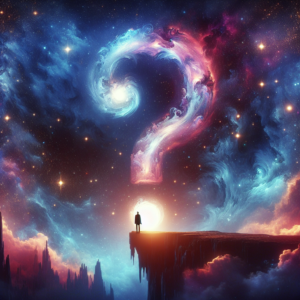
God is the Question: Not the Answer
Larry Frederick Peterson Ph.D. (C) Copyright 2026
A radical reimagining of existence itself: uncertainty isn’t a bug in human life, it’s the feature. Drawing on physics, psychology, and theology, Peterson argues meaning survives only where questions remain open. Our greatest threat isn’t chaos, but premature completion.
What happens when a civilization gets everything it wants?
We are building a world engineered for convenience, prediction, and safety—where AI answers our questions before we ask them, where algorithms curate our desires, where friction is treated as failure. We call this progress. But what if we’re accidentally engineering our own obsolescence?
GOD Is The Question, Not the Answer presents a radical thesis that cuts across physics, psychology, theology, and technology: Uncertainty is not a defect to be eliminated—it is the sacred architecture of meaning itself.
Dr. Peterson argues that:
• Gratitude collapses when gradients collapse. When everything becomes easy, nothing feels meaningful. The nervous system, built for scarcity, goes numb in abundance.
• Fulfillment syndrome is real. From lottery winners to billionaires, those who “arrive” often discover that completion feels less like paradise and more like senescence.
• We are outsourcing agency itself. AI writes our emails, recommends our choices, predicts our preferences—and in doing so, flattens the very friction where free will learns to stand.
• Entropy is mercy, not punishment. The Second Law of Thermodynamics isn’t cosmic cruelty—it’s the mechanism preventing any system, any civilization, any answer from becoming permanent prison.
• God is the question keeping reality open. If divinity exists, it exists not as final certainty, but as the eternal invitation to participate, to choose, to become.
This book doesn’t promise answers. It protects the space where answers remain possible. It’s a manifesto for incompleteness, a theology of openness, and a warning: A world that solves every problem risks eliminating the only thing that makes life worth living—the question itself.
If the universe is a question, then living is participation. And the existential question is waiting for you.
– —
We are living through a quiet crisis. Not a collapse of civilization. More a collapse of uncertainty. A world engineered for convenience, prediction, optimization, and safety precipitously drifting toward something stranger and more dangerous than chaos. Completion is death in slow motion. Drawing on physics, psychology, theology, and the living texture of modern life, The Question argues a radical thesis: uncertainty is not a flaw in human existence. Uncertainty is the architecture of human existence. Remove uncertainty and we erase the gradients where agency forms, where curiosity ignites, where meaning takes shape. Where love becomes brave, where identity becomes earned rather than installed.
Entropy is not cosmic vandalism; it is cosmic mercy. Free will is not a metaphysical luxury; it is the universe’s refusal to prematurely close its own story. Convenience is not neutral; it can anesthetize the very capacities making life feel vital. Completion is not triumph; it is senescence. Incompleteness is not failure; it is grace.
Meaning survives only where uncertainty survives. This is not a call to embrace suffering. It is a call to embrace openness. Not as resignation. As rebellion. The sacred lives in the unfinished. Curiosity becomes resistance. Gratitude becomes sovereignty. Hope becomes a deliberate act rather than a prediction.
This book does not promise answers. It protects the space where answers remain possible. If the universe is a question, then living is participation. And the existential question awaits us.
PREFACE — The Book That Could Not Be Written Earlier
My argument begins with suspicion. Something essential in human life is thinning, not through catastrophe, but through convenience. The world strives to grow safer, smoother, faster, more optimized, and yet people feel more brittle, more restless, more numb to experience. The paradox looks psychological at first, then cultural, then civilizational. Eventually, the paradox resembles a metaphysical heart attack. A pattern emerges across domains once considered unrelated. Education, technology, medicine, theology, cosmology, and ethics reveal the same drift towards idealized completion. Completion is portrayed as triumph. What if the consequences of completion behaves more like senescence?
The more I consider this drift, the more I realize the crisis may not stem from boredom, burnout, or malaise. An oversimplification might attribute it to loneliness, nihilism, or decadence disguised as progress. The crisis might best be attributed to the gradual erosion of the question. The erosion of uncertainty. The erosion of the gradients where agency learns to stand. Ultimately, the erosion of curiosity.
My argument is not intended as lament. My observations put forth a wager. Meaning survives only where uncertainty survives. Free will is not a luxury. Free will is a structural necessity. Entropy is not a cosmic insult. Entropy is cosmic mercy. The sacred lives not in answers, but in the open space where questions remain possible. When answers lead to more questions, the fundamental weave of agency survives.
My argument is not to provide comfort. My argument is designed to clarify. To protect the conditions under which human life can remain alive from the inside and protest the conditions where agency is lost. If the universe is a question, then living is participation. My argument is an invitation to participate.
FOREWORD
The argument is simple enough to state and far more difficult to live: God is not the answer waiting at the end of inquiry. God is what makes inquiry meaningful. If the universe has a sacred center, it resides beyond certainty. I argue God is the refusal of certainty. Life is the perpetual widening of possibility. An existential wheel without a circumference. What we call “God” may be the name we give to the ultimate question. The Logos keeping existence from collapsing into completion and entropic senescence.
The universe is not a puzzle to solve. The universe is an ongoing question giving meaning to life. Our incompleteness is not a flaw in our design. Our incompleteness is the design. Life gains meaning from imperfection. From the open space between what we know and what we strive to discover.
The Big Bang represents far more than an explosion of matter and energy. Consider it the universe’s first act of inquiry. Consider it reality waking in an instant, flinging itself outward with a single, enigmatic question: what can I become? For roughly 13.8 billion years, the universe answers in a proprietary language expressed as form. Stars learned to burn. Galaxies learned to swirl. Planets learned to hold heat long enough for chemistry to create history. Life emerged as fragile defiance against a cooling cosmos, gathering itself into pockets of improbable complexity and order. Then, improbability bordering on impossibility, the universe answered with humans, with consciousness, with awareness, with the strange interior light by which existence notices itself through the mirror of human curiosity.
It is difficult to look at this arc without hearing, beneath it, cosmic inquisitiveness. Are we a biological accident learning to ask questions? Or are we the universe’s reflection, the place where the creative force looks back on itself and considers what it has done, and what it might yet do?
If the universe is 13.8 billion years old and designed to function for trillions more, humanity cannot be considered the main character in the play. We may be a brief flare. Brevity does not make us meaningless. Meaning is not measured in duration. A Bach cello suite does not become trivial because it ends. The question is not whether we are central. The question is whether we remain meaningful participants while we participate in the miracle. If other conscious beings exist, the universe enjoys additional mirrors. Sacredness is not diminished when shared. Sacredness multiplies.
Participation carries responsibility. If we accelerate destruction, if we burn futures into ash for short‑term comfort, we might be relinquishing our status as co‑authors of the question. By extension, we act as careless editors deleting pages in the Book of Life. Entropy may be universal, but reckless forfeiture is optional. There is a difference between living inside finitude and weaponizing finitude against everything fragile. If curiosity is sacred, as I propose, the biosphere is not mere scenery. The biosphere is the profound library where questions are cultivated and stored.
Imagine carrying curiosity to its apparent limit. Imagine we ask every potential question, exhaust every horizon within reach, explore every possibility accessible to us, and through technology or time or some combination of both, fulfill everything fulfillment can offer. Imagine a world where the appetite driving us from caves to cathedrals and now to computers finally runs out of room. Imagine nothing remains outside our grasp or remains uncertain enough to be worth chasing.
What would the reward be for such completion? Bliss? I think not. Heaven? Not necessarily. Perhaps the reward is something quieter, more natural, more unsettling. Perhaps the answer is senescence. Not because we failed. Not because we are punished. Senescence arrives because the chapter is finished. A finished chapter does not keep producing new pages. When the medley reaches completion, the subsequent move is rest. Perhaps rest is simply what completion feels like from the inside.
Here sacredness begins to reveal itself, not in certainty, but in its opposite. What makes life sacred may not be longevity, comfort, or moral cleanliness. What makes life sacred might be irresolution. We can anticipate the next chapter but we do not know whether a next chapter will come. Because we do not know, the gap between completion and whatever follows becomes luminous. Meaning may live precisely in the narrow, enigmatic corridor where the universe has done what it set out to do, and does not know what it will do next. The meaning of existence might hover between exhale and inhale. The meaning of life might reside in uncertainty, in the longing, in the effort, and in the forfeiture of second attempts.
We are taught the goal of life to reach Heaven? Consider another possibility. Perhaps the goal of a meaningful life is to remain forever in pursuit of Heaven. Not as consolation but as an exquisite form of ongoing curiosity. The drive to seek, to hunger, to desire may be less a curses than a gift. The point of existence may not be satiety. The point may be sustained appetite without final satisfaction, the preserved yearning keeping the story going. If God is present in human experience, perhaps God is not the answer ending the conversation. Perhaps God is the question keeping the conversation going. Curiosity is not a childish habit we outgrow. Curiosity is the enigmatic cosmic engine turning energy into complexity, chaos into order, and existence into meaning. Curiosity becomes the force refusing to let reality collapse into mere repetition.
Curiosity is real and not an illusion inside a prewritten script. Curiosity requires a world where things can genuinely proceed differently. Free will enters here, not as a moral trap, not as a cosmic test, but as the miraculous mechanism ensuring the question remains ongoing. If everything were decided in the initial conditions of the Big Bang, existence would become a deterministic recording wearing the mask of a live performance. We would not be participants. We would be spectators watching inevitability unwind in slow motion. Free will insists something more dangerous and far more beautiful: possibility. The future does not merely unroll from the past. The question is not staged. Possibility is not decorative. Free will keeps the universe from finishing itself before it begins. Free will keeps us from becoming well‑dressed automatons performing legacy without agency.
Which brings us to entropy, the word we have been taught to fear. The shadow falling across joy and achievement. Entropy is the physical law written into matter whispering: everything disperses, everything flattens, everything ends. But what if entropy is not the enemy. What if entropy is mercy. What if entropy promises no ending is final, not because a reset is guaranteed, but because perfection is never permitted to become a cage. A system in perfect equilibrium is a dead system: no gradients, no tension, no work, no change, no becoming. If Heaven is imagined as eternal completion, eternal certainty, eternal arrival, then Heaven begins to resemble the very thing we dread most: stasis. Entropy might be considered cosmic kindness preventing completion from hardening into prison bars. Entropy might be the assurance nothing remains frozen forever, certainty never gets the last word, even the most finished state dissolves back into openness and renewal.
Consider, then, the possibility the cosmic cycle itself is the epitome of God’s gift. Not as comfort, but as release. Not guaranteed happiness, but refusing the trap of the unbearable stillness of perfection. If the universe is a question, the cycle of death and renewal keeps the question alive across time. And we, restless and incomplete, are not mistakes within the cycle. We are its most intimate expression. Free will ensures we are never reduced to mere observers of a predetermined script. We are co‑authors, writing the universe’s story with every choice, every question, every act of defiance against the flattening pull toward completion. We are not gods. We are not machines. We are not predetermined outcomes. We are humans, choosing, climbing, asking, alive, because the question remains unfinished. The question, in the deepest sense, is God.
What follows begins not with theology, but with physics, psychology, and the lived texture of modern life. To understand why God is the question, it is wise to consider what happens when a life, or a civilization, runs out of questions.
OPENING
If the universe depends on gradients to generate becoming, meaning depends on the same architecture. Part I examines what happens when gradients collapse; not in theory, but in the emotional weather of our time.
Scientists like to say God hates a vacuum. The line circulates as physics humor, but it hides a confession. Emptiness refuses to remain empty. A void pulls forces into motion, pressures rise, fields tremble, matter gathers, and blank space begins to teem. Consider a deeper reading. The vacuum does not merely invite substance. The vacuum energizes curiosity. Absence behaves like provocation. Existence responds the way a mind responds to an unanswered question, compelled to fill open space with form, with pattern, with wonder.
The universe does not punish curiosity. The universe rewards curiosity with existence. It keeps opening doors to new beginnings. It keeps generating rooms behind rooms. It keeps offering novel horizons for appetite to chase. Yet every appetite has a limit. Every horizon eventually collapses into a wall. Curiosity, like any fire, needs oxygen. Free will needs meaningful alternatives. When curiosity runs out of room to expand, when free will runs out of choices carrying real stakes, existence does not erupt in rage or collapse in moral judgment. Existence simply exits with manners. Existence quietly leaves the stage. Not as punishment. As completion. As senescence, spoken quietly, almost tenderly signaling an end to the this chapter and a time to rest before the next act.
INTRODUCTION — The Shape of the Question
Every civilization tells a story about what it means to be alive. Some stories center on obedience. Others on progress. Some focus on salvation. Others on liberation and survival. The current paradigm focuses on optimization. Same day shipping. One hour food delivery. No waiting. Drive through prescriptions. We have built a world where friction is treated as failure, uncertainty as defect, limits as bugs, and difficulty as poor design. We have built tools capable of smoothing every edge, predicting every preference, anticipating every desire, and removing every inconvenience.
We call this convenience. We call this progress. We call this personalization. We rarely ask what happens when a species built for uncertainty loses contact with it.
My argument proposes a simple, unsettling thesis: uncertainty is not a flaw in human life. Uncertainty is the architecture of human meaning. Remove uncertainty and we remove the conditions under which agency, courage, curiosity, love, responsibility, and identity can exist. Remove uncertainty and we do not default to paradise. We get stasis. We get free floating weightlessness. We get a life without narrative shape. We get a civilization drifting toward ontological heat death.
Entropy becomes metaphor, mirror, warning, and mercy. Across physics, theology, psychology, ethics, and technology, the same pattern repeats: life requires gradients. Meaning requires gradients. Free will requires gradients. My argument is not a call to embrace suffering. It is a call to embrace incompleteness, not as punishment, but as grace.
The chapters ahead trace a single arc: from the outsourcing of agency, to the erosion of curiosity. From the metaphysics of free will, to the cosmic role of entropy, underscoring the ethical demands of a world capable of deleting uncertainty at scale. The argument grows from personal to civilizational and finally to the cosmic scale, because the crisis grows along the same path.
If the universe is unfinished, then so are we. Unfinished is not a flaw. Unfinished is the expression of meaning.
Quantum computing is often sold as a route to omniscience, as if enough qubits could finally close the book of the unknown. The reality is more subversive. A quantum computer runs on structured uncertainty, superposition shaped by interference. It cannot cash out uncertainty into unlimited certainty. The moment an answer becomes definite, the system pays an irreversible price. Measurement collapses possibility into history. The discarded alternatives cannot be recovered as lived options. Even here, at the frontier of computation, the universe refuses completion. Uncertainty is not a defect we are waiting to cure. It is the operating system making work, change, and meaning possible.
PART I: THE CRISIS WE’RE LIVING
Chapter 1: The Gratitude Collapse
Gratitude collapses when gradients collapse. A nervous system built to chase difference cannot thrive in a world engineered to eliminate magnitude just as we cannot teach a summer insect about winter.
Imagine scrolling through your phone, bored to the point of irritation. Not exhausted. Not grieving. Not fighting for survival. Unimaginably bored. We hold a device offering more knowledge than any ancient library, more music than any king could commission, more faces than any village could contain. We can summon almost any fact, any voice, any image. We can speak across oceans in seconds. Our ancestors would have mistaken us for a god. Meanwhile, we sit in a small rectangle of light, killing time, waiting for something, anything promising to feel interesting, to feel alive.
Now imagine winning the lottery. The first days arrive like a fever dream. The body floods with joy, the mind races ahead, life turns luminous with long list of possible opportunities. Then, within months, the brightness dims. Within a year, many winners return to a familiar baseline. Psychologists call it hedonic adaptation, the hedonic treadmill, the nervous system’s brutal talent for reducing miracles into normal. The new house becomes “the house.” The new freedom becomes “life.” The extraordinary becomes furniture. We still own it, but it no longer moves us. The miracle stops registering as extraordinary. It becomes background noise.
Distinction matters, because language can wound when complexity collapses. “Depression” is not one symptom. Depression is remarkably complex: neurobiological dysregulation, sleep disruption, reward circuitry malfunction, inflammation, trauma imprinting, endocrine chaos, genetics, all braided together. Sometimes depression is situational and moral injury. A nervous system responding sanely to an insane environment. Sometimes depression is what I describe elsewhere: existential depletion inside a world engineered to erase too many meaningful gradients.
These can overlap inside one body. They are not interchangeable. They do not require the same response. If medication, therapy, community, exercise, light, or trauma treatment lifts someone’s depression, this does not “disprove” the metaphysical frame. It proves something simpler: the system was injured, and repair is real. Treating depression is not cheating. It is not delaying a noble completion. It is restoring a person’s access to choice, to agency.
If my argument sounds like spiritualizing despair, read me as saying the opposite: our agency matters enough to protect it. Sometimes the first act of free will is not a heroic quest. Sometimes it is accepting help. This is not a niche tragedy. It is a civilizational mood. Wealth rises, convenience multiplies, entertainment becomes limitless, and the emotional readout fails to rise with it. In the United States, material abundance has surged across the last century. Reported happiness has not climbed in proportion. In many developed nations, depression diagnoses and anxiety disorders have expanded into a background weather system. Anhedonia, the inability to feel pleasure, appears with grim regularity as a defining symptom. Many people do not appear melodramatically miserable. They appear flat. Not broken in a way visible from across a room. Hollow in a way felt most clearly at night, alone, when the glow of the screen no longer distracts. Durkheim had a word for this atmosphere: ennui. Quiet desperation wearing clean clothes.
Underneath the mood resides a nervous system designed for scarcity. Dopamine does not exist to reward abundance. Dopamine exists to drive pursuit. It spikes with novelty, with possibility, with the feeling of reach. When stimulation becomes constant, the brain compensates. Tolerance rises. The old hit stops hitting. Entertainment responds by growing louder. Action scenes escalate until physics becomes optional. Horror adds gore, then adds more. News, competing for attention, speaks in alarms, because calm reality cannot compete with panic. YouTube videos post hyperbole to get clicks and revenue. “Stay to the end of the video,” has become the universal catchphrase to get paid on completion metrics and ad revenue. The cultural volume knob only turns one direction: up.
History offers uncomfortable echoes. Late Rome, rich and bored, did not lack spectacle. It drowned in spectacle. Bread and circuses grew more extreme as meaning grew more scarce. The Qing elite, swollen with comfort, slipped into opium haze, not only from pain but from emptiness. Neither civilization collapsed purely from invasion or bad luck. They softened from inside. Apathy spread. A culture can die without a dramatic funeral. A culture can fade. A culture can enter senescence.
There is a medical version of this story. The metaphor is harder to dismiss. Human brains are not built for sheer comfort. They are built for engagement, input, challenge, novelty, feedback, and social contact. When those forms of stimulation thin out, the consequences often don’t remain philosophical. They show up as symptoms: withdrawal, agitation, anxiety, depressed mood, a shrinking tolerance for silence, and a stubborn sense of malaise where nothing feels worth doing.
With age, the pattern becomes clearer. A mind going long stretches without meaningful engagement declines faster than a mind challenged through conversation, learning, music, movement, problem-solving, or simply having a reason to pay attention. I am not lecturing. Consider my observation maintenance physics. The brain is plastic, but plasticity is not automatic. What we don’t use, weakens capacity, not as punishment, but as the nervous system reducing resources.
Even sensory loss functions like quiet deprivation. When hearing, sight, and touch diminish, the world becomes less textured. Fewer inputs arrive. Fewer differences make a difference.” And when the world flattens, personhood flattens with it, not because we lack gratitude, but because gratitude requires contrast, and contrast demands challenge and contact.
When a civilization engineers life to minimize friction, it may also be engineering something else: a slow reduction in the very challenge keeping minds alive from the inside. Civilizational senescence does not necessarily mean failure. It can indicate excessive completion. It can reveal a system exhausting its gradients. The games become more grotesque because ordinary pleasure no longer registers. The distractions become more constant because silence becomes intolerable. The reward for success becomes exhaustion, not because life punishes achievement, but because completion leaves nowhere meaningful left to go.
We occupy a strange position in human history. We have more access, more comfort, more choice, more arousal than any previous generation could imagine. Despite this benchmark, many of us feel less. Not nothing. Less. Less of life’s sacred quality. Less awe. Less gratitude. Less appetite for ordinary beauty. Less patience for friction, delay, difficulty, uncertainty. We treat miracles as background noise. Is this progress?
So ask the question driving this chapter, and perhaps the entire argument. If we become the first civilization to have everything and feel nothing, wherein lies the meaning? Will we be too sedated to recognize end credits rolling in slow motion because the collapse of gradients is not only cultural, it is biological.
END OF SAMPLE