
Fantasy/Romance
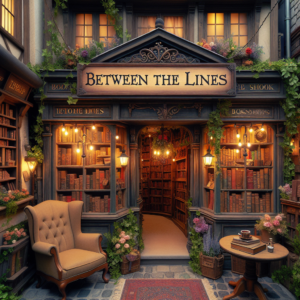
Bookshop Between Worlds
Lawrence F. Peterson
A love story for readers who’ve ever used fiction as shelter—and wondered what it would take to step back into life.
When Ann Marsh inherits her grandmother’s struggling New Hampshire bookshop, she expects debt, dust, and hard choices—not a hidden journal describing an impossible secret: Eleanor could slip into the worlds of beloved stories, meeting a man she loved across the pages of books.
Ann doesn’t believe in magic. But on a stormy night, reading aloud by candlelight, she’s pulled into a glittering ballroom—and into the path of James, a stranger who shouldn’t exist… except he’s real. He’s in Singapore. And like Ann, he’s been hiding from heartbreak inside the safety of stories.
As Ann and James learn to find each other again and again—through classic novels, unforgettable scenes, and the emotional truths that bind them—their connection deepens into something tender, terrifying, and real. But when the magic falters, they’re forced to confront the question they’ve avoided from the start:
Is their love only possible in fiction—or are they brave enough to choose each other in reality?
THE BOOKSHOP BETWEEN WORLDS is a sweeping romantic novel about grief and healing, the ache of second chances, and the courage it takes to stop escaping—and start living. It represents a magical romance about finding love in stories and choosing it in real life.
—
Chapter 1: The Inheritance
PRESENT DAY, COASTAL New Hampshire, LATE AUTUMN
Ann Marsh stood in “Between the Lines,” the bookshop she inherited from her grandmother Eleanor six months ago. The shop appeared beautiful but crumbling, peeling paint, creaking floors, stacks of unsold inventory. Yet magic lived in the chaos: first editions in glass cases, reading nooks with worn velvet cushions, a spiral staircase leading to rare book collections, and everywhere, everywhere, the smell of old paper and magic ensconced in old, classical literature.
Rain pelted the windows as Ann moved through the stacks, trailing her fingers along spines she knew by heart. She could quote passages from most volumes like prayers, recite opening lines, closing paragraphs, pivotal scenes. The books became her closest companions since Doug Morrison, her high school sweetheart, left her at the altar two years prior.
Ann paused by the poetry section, straightening volumes of Dickinson and Frost. Her reflection caught in the antique mirror hanging between bookshelves, pale skin, dark circles under her eyes, brown hair pulled back in a messy bun. She wore her grandmother’s reading glasses even though her vision remained perfect. The vintage frames made her feel less alone, more connected to Eleanor and the legacy she’d inherited.
The shop bell jingled. Sarah Mitchell, Ann’s oldest friend, bustled in, shaking raindrops from her umbrella. Her cheeks were flushed from the cold.
“I brought sustenance,” Sarah announced, holding up a paper bag from the local bakery. “Blueberry muffins and coffee. When did you last eat something not consisting entirely of tea and toast?”
Ann smiled despite herself. Sarah appointed herself Ann’s personal guardian since the disaster with Doug. She checked in regularly, bringing food, attempting to drag Ann back into the world of the living.
“I had soup yesterday,” Ann defended, accepting the coffee gratefully. “From a can, but still technically food.”
Sarah rolled her eyes, perching on the counter. “Any exciting customers today?”
“Three. Mrs. Abernathy bought a gardening book. The Henderson twins browsed but didn’t purchase anything. A tourist couple asked directions to the lighthouse.”
“Thriving business model,” Sarah commented dryly. “Maybe you could sell maps.”
Ann sighed, glancing around the empty shop. Business declined steadily since Eleanor’s death. She was the linchpin keeping the place going. The shop barely covered expenses most months. Bills piled up. Necessary repairs loomed but were not affordable. The mortgage was becoming a stretch despite renegotiations with the bank.
“You need actual people in your life,” Sarah insisted, reprising her monthly attempt to drag Ann into town life. “Living, breathing humans who talk back,” her familiar mantra.
“My characters talk back,” Ann replied, tapping the cover of her worn copy of Jane Eyre. “They’re far more reliable.”
“Books won’t keep you warm at night.”
“Neither did Doug.”
Sarah winced. “Ouch. Low blow.”
“Sorry.” Ann sipped her coffee. “I’m fine, Sarah. Really. The shop keeps me busy.”
“Too busy to join me and Marcus for dinner Friday? He’s bringing his friend Paul. Single, veterinarian, loves reading.”
Ann realized she shook her head too quickly. “I have inventory to do. But thank you for the offer.”
“You always have inventory to do, Annie.”
“Because I always have books.”
Sarah sighed, recognizing a lost cause. “One day, Ann Marsh, you’ll have to rejoin the land of the living. Your grandmother wouldn’t want you hiding away in here forever.”
After Sarah left, Ann flipped through the ledger, numbers blurring before her eyes. The financial reality looked grim. Without a significant upturn in business, the shop might not survive another year. Sarah didn’t realize how hard it is to feel festive, when foreclosure looms.
Eleanor never worried about profit margins or quarterly sales. The shop was her passion, not her livelihood. She received support from a modest inheritance from her late husband. Ann lacked such financial cushioning. The shop represented her sole income, her home, her purpose.
As evening approached, Ann flipped the sign to CLOSED and locked the front door. She climbed the narrow stairs to her apartment above the shop, a quaint space filled with antiques inherited from Eleanor. She rarely ventured beyond these walls anymore. The bookshop provided everything she needed: purpose, comfort, and safety from a world where people made promises they didn’t keep.
She prepared tea and settled into her evening ritual. Every night, she read aloud to the empty shop, as if the books and invisible guests listened. Tonight, she selected Pride and Prejudice, a first edition carefully preserved in a glass case during business hours but removed for her private readings.
The bell above the door jingled, startling Ann from her reverie. She glanced up to see a woman in her forties with kind eyes and an expensive coat. She shook rain from her umbrella.
“I’m sorry,” Ann said, rising from her chair. “We’re closed.”
“I know. I saw the sign.” The woman smiled apologetically. “I’m Victoria Childs. I called earlier about making an offer on the building?”
Ann hesitated. She vaguely remembered a voicemail she ignored, assuming it came from another developer hoping to turn the historic building into vacation rentals.
“I don’t recall,” Ann said. “I left several messages.”
Victoria approached, extending her hand. “I understand your reluctance. This place must hold significant memories.”
Ann nodded, shaking Victoria’s hand. “My grandmother saved this shop and made it what it is. She dedicated her life to it.”
“I know.” Victoria’s expression softened. “I knew Eleanor. Not well, but enough to respect what she created here.”
Ann gestured toward the reading area, curious despite her wariness. “Please, sit. Would you like tea?”
Victoria settled into an armchair while Ann prepared another cup. When Ann returned, Victoria was examining a photo of Eleanor on the wall. The photo showed Eleanor at sixty, silver-haired and elegant, and surrounded by her passion, books.
“She had remarkable taste,” Victoria commented. “In books and people.”
“You mentioned an offer?” Ann prompted, handing Victoria her tea.
Victoria nodded, opening her briefcase. “Five hundred thousand dollars for the building. I want to convert it into a bridal boutique.”
Ann nearly choked on her tea. The amount exceeded her wildest expectations, enough to pay off the shop’s debts, secure a comfortable future, perhaps even buy a small place to live.
“A bridal boutique?” she repeated.
Victoria’s eyes grew distant. “A memorial, really. To my partner Grace. She proposed to me in this very shop fifteen years ago.”
“Here?” Ann blinked in surprise.
“Right by the poetry section.” Victoria smiled at the memory. “Your grandmother let us have our commitment ceremony here too, in the stacks, surrounded by love stories. It was the happiest day of my life.”
Ann tried to imagine the bookshop transformed, wedding dresses where classics now stood, veils hanging where first editions resided. The image hurt more than she expected.
“Grace passed away last year,” Victoria continued. “Cancer. Before she died, she made me promise to stop putting off my dreams. We always talked about opening a boutique together someday.” Her voice caught. “I want to honor her memory. Create a place where other couples can find their happiness.”
Ann felt a pang of empathy. She understood grief, understood clinging to memories of someone beloved.
“Why this building specifically?” she asked. “Surely other locations would work.”
“This place has… magic.” Victoria gestured around the shop. “You feel it, don’t you? A sense of possibility. Grace felt it. Your grandmother cultivated it. I want to preserve it, just channel it a bit differently.”
She slid a contract across the table. “Take your time. Think about it. I’ve included a 90-day consideration period.”
After Victoria left, Ann stared at the contract sitting on the counter like a guillotine. The offer was generous, more than generous. But selling meant losing her last connection to Eleanor, and admitting she failed to keep her grandmother’s legacy alive.
The thought devastated her.
Ann poured herself a glass of wine and carried it upstairs to her apartment. Rain continued to pound against the windows, matching her turbulent mood. She curled up in the window seat, watching lightning illuminate the small coastal town below. The apartment was a priceless gem time forgot. It exuded memories and comfort like a warm blanket. Here she could truly relax for as long as she could hold on to the shop.
Seabrook, New Hampshire was her home her entire life. She knew every cobblestone street, every shopkeeper, every local legend. The bookshop stood on Main Street since 1924, a constant in a changing world. Tragically, she considered she might be the one to end its story? The thought generated unsettling anguish.
The storm intensified as night deepened. Wind howled around the old building, seeking out every crack and crevice. Ann descended to the shop to check for leaks, a common occurrence during coastal storms.
Water dripped steadily from a spot near the fireplace, a persistent problem Eleanor never properly addressed. Ann placed a bucket beneath the leak, then knelt to examine the ancient brick fireplace. One brick appeared loose with water around its edges.
She wiggled the brick to check for damage behind. To her surprise, it slid out easily. A small cavity resided behind the brick. Inside lay a leather-bound journal.
The cover bore her grandmother’s initials: E.M. Eleanor Marsh.
Ann carried the journal to her reading chair, her heart racing. How was it she never discovered this during the months she lived here? How long had Eleanor hidden it away?
She opened the journal with trembling fingers. The entries appeared cryptic, filled with references to “meeting him in stories” and “the magic of emotional resonance.”
The journal seemed organized by book titles. Each entry described a meeting:
“Casablanca – Rick’s Café. Books, we found, included films. We danced. He held me like I was the only real thing in a world of shadows. I’ve never felt so seen.”
“Anna Karenina – The ball. We waltzed through Tolstoy’s glittering world. He told me about his bookshop in Paris. I told him about mine in New Hampshire. We laughed at the impossibility of it all.”
“Wuthering Heights – The moors. Too intense. We argued about whether love should consume or complete. I think we were really arguing about whether to meet in reality. We were both afraid.”
Ann turned page after page, her confusion growing. Her practical, no-nonsense grandmother wrote about entering books, meeting someone named Thomas, and experiencing fictional worlds as if they were real.
“The Great Gatsby – His mansion during a party. The music swirled around us like physical manifestations of desire. Thomas kissed me beneath fireworks exploding over the bay. I felt myself falling, not just for him but for the possibility of him. For what we might become together, outside of the books.”
“Pride and Prejudice – The Netherfield Ball. We danced and discussed our real lives. Thomas told me about his bookshop in Paris. How he inherited it from his father. How the occupation nearly destroyed his family’s life there. He told me stories of his father he carried like scars. I told him about building mine from nothing after my parents died. How books saved me from drowning in grief.”
The entries continued for years, meetings in dozens of books. Eleanor and Thomas, finding each other again and again in fictional worlds while their real lives continued separately.
The final entry, dated one week before Eleanor’s death, made Ann’s heart ache:
“Fiction is beautiful, but love must be real to become whole. I waited for him to come to me. He waited for me to come to him. We both waited until it was too late. Thomas fell ill. We lost contact. I forever wondered what might have been. I’ve been alone here in New Hampshire after Henry died, continually wondering how things might have been different had Thomas and I not been cowards.
If the magic finds whoever reads this (and I believe it will, magic seeks the lonely, the broken, the readers). Don’t make my mistake. Choose reality, even when it terrifies you. Choose the person, not the portal if you discovered it. Choose real.”
Ann closed the journal, her mind racing. Eleanor never mentioned anyone named Thomas. She never spoke of magic or portals or meeting people inside books.
Ann felt compelled to do what her grandmother did every night: read books by candlelight. She elected to read Pride and Prejudice.
She retrieved the first edition from its case, handling it with reverence. The leather binding felt warm beneath her fingers, alive. She settled into her reading chair and began reading aloud, as always, to the empty shop.
“It is a truth universally acknowledged, a single man in possession of a good fortune, must be in want of a wife.”
The familiar words comforted her as the storm raged outside. She read steadily, losing herself in Austen’s world of manners and misunderstandings. When she reached the Netherfield Ball scene, the candle flame flickered strangely, stretching impossibly tall.
Ann paused, a shiver running down her spine. The air in the shop felt suddenly charged, as if with electricity. The words on the page began to blur, the letters swimming before her eyes.
“However little known the feelings or views of such a man may be on his first entering a neighborhood, this truth is so well fixed in the minds of the surrounding families…”
The room began to spin. Ann gripped the arms of her chair, dizzy and disoriented. The candle flame grew brighter, illuminating the shop with unnatural light.
She felt a pull, like gravity reversing.
The bookshop dissolved around her.
The last thought before everything changed: Eleanor wasn’t crazy after all.
END OF SAMPLE