
Landscapes & Environments
Slide shows offer a partial selection of my artwork with provision to purchase high quality Giclee canvas prints.
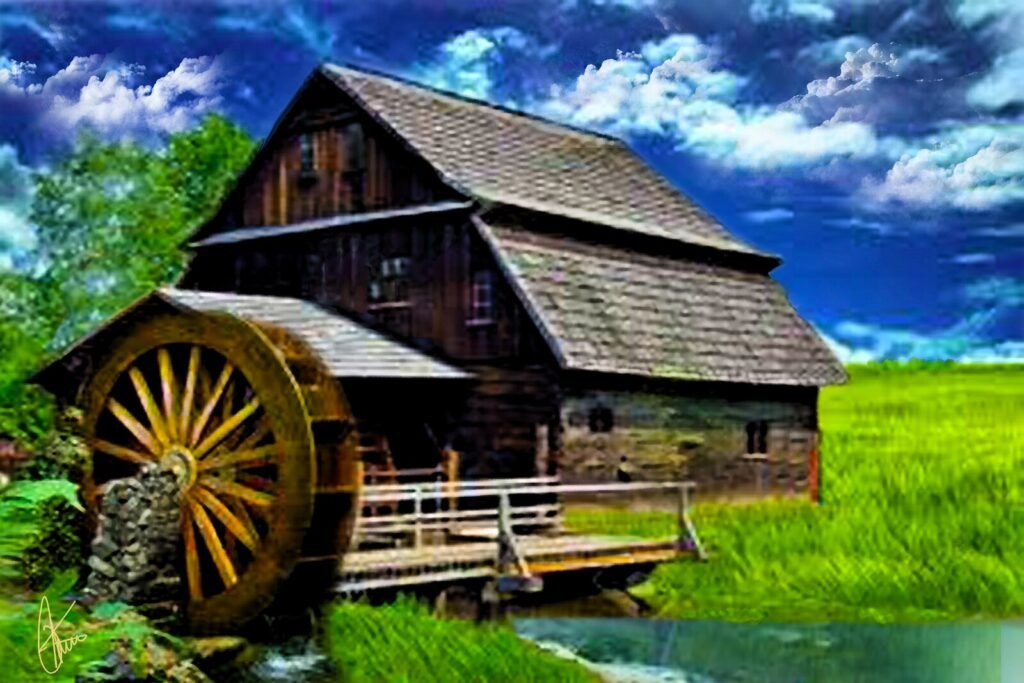
There is a quality of heightened remembrance to this rendered landscape — a scene so saturated with color and atmosphere that it transcends documentation and enters the realm of the idealized, the deeply felt. A historic grist mill, its weathered timber walls dark with age and moisture, sits at the water’s edge with the settled permanence of something that has outlasted generations. The great wooden waterwheel at its side — golden, spoked, and beautifully preserved — is the composition’s undisputed focal point, a symbol of human ingenuity in harmony with the natural world that carries the quiet weight of an earlier America.
The artist’s hand is most evident in the treatment of color, which has been pushed well beyond photographic naturalism into something closer to pastoral poetry. The surrounding meadow blazes in an almost supernatural chartreuse green, the kind of green existing more in memory than in nature — the green of a perfect summer afternoon recalled years later. Above, a deep cerulean sky billows with luminous white clouds that carry the drama of a Turner seascape, their forms dynamic and full of movement against the saturated blue. This chromatic intensity draws the eye upward and outward, giving the modest mill an almost heroic setting, as though the landscape itself is paying tribute to it.
What the work achieves, ultimately, is a form of emotional preservation. The mill is rendered not merely as architecture but as feeling — the feeling of rootedness, of craft, of a slower and more deliberate relationship between human beings and the land they inhabit. The artist’s signature, visible at the lower left, marks this not as a record but as an interpretation — a personal vision of a vanishing world made luminous and lasting through the transformative power of art.
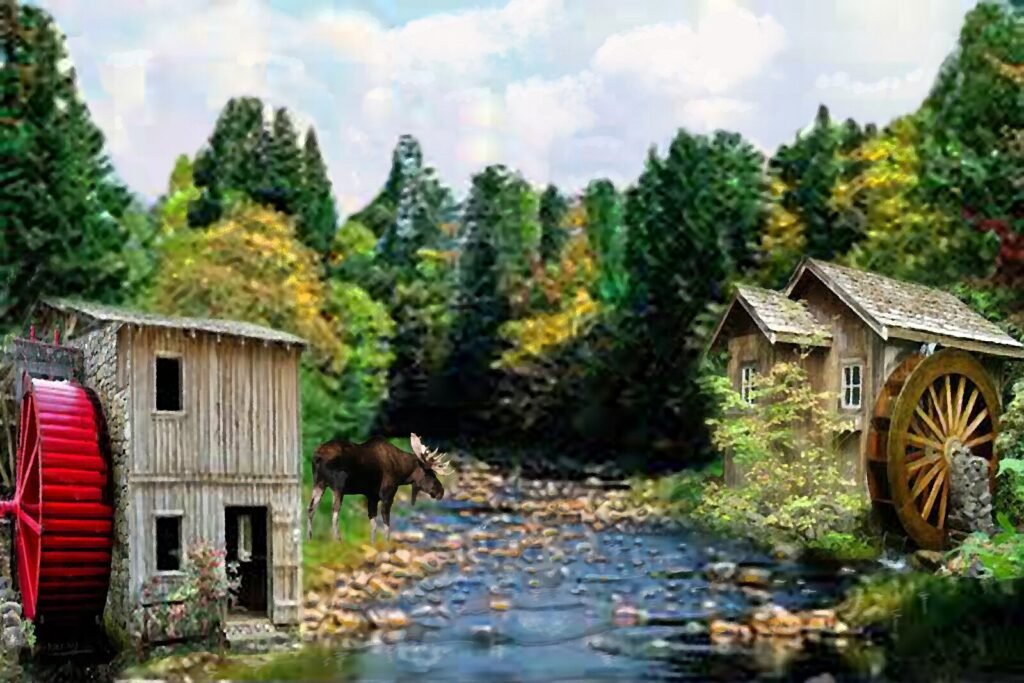
There are images that stop time, and this is one of them. A bull moose stands at the center of a rocky, shallow river, head bowed in the unhurried manner of a creature entirely at home in its world — and in doing so, becomes the still point around which the entire composition breathes. Flanking him on either bank, two historic grist mills face each other across the water like old sentinels: one bearing a vivid crimson waterwheel on the left, the other a warm golden wheel on the right. The symmetry is deliberate and deeply satisfying, creating a sense of balance that feels less designed than discovered — as though the artist simply found the world arranged this way and had the wisdom to preserve it.
The forest backdrop is rendered with lush, painterly depth, its layered canopy moving from the deep evergreen of spruce and fir in the foreground to the warmer, yellowing tones of early autumn further back — a seasonal transition caught mid-breath, the trees not yet fully committed to their turning. The river corridor draws the eye deep into the composition along a natural vanishing point, creating a sense of distance and wilderness that extends far beyond the canvas edge. The digital treatment lends the foliage a richly textured, almost tactile quality, somewhere between plein air painting and fine art photography — a hybrid language perfectly suited to a subject that itself exists at the threshold between the cultivated and the wild.
What elevates this work beyond picturesque landscape is its quietly profound sense of coexistence. The mills speak of human industry; the moose speaks of something older and indifferent to industry entirely. And yet here they share the same river, the same light, the same moment — neither diminished by the other’s presence. It is a vision of the natural and the man-made not in conflict but in a kind of earned, fragile accord, rendered with enough beauty and technical skill to make that vision feel not merely possible, but true.
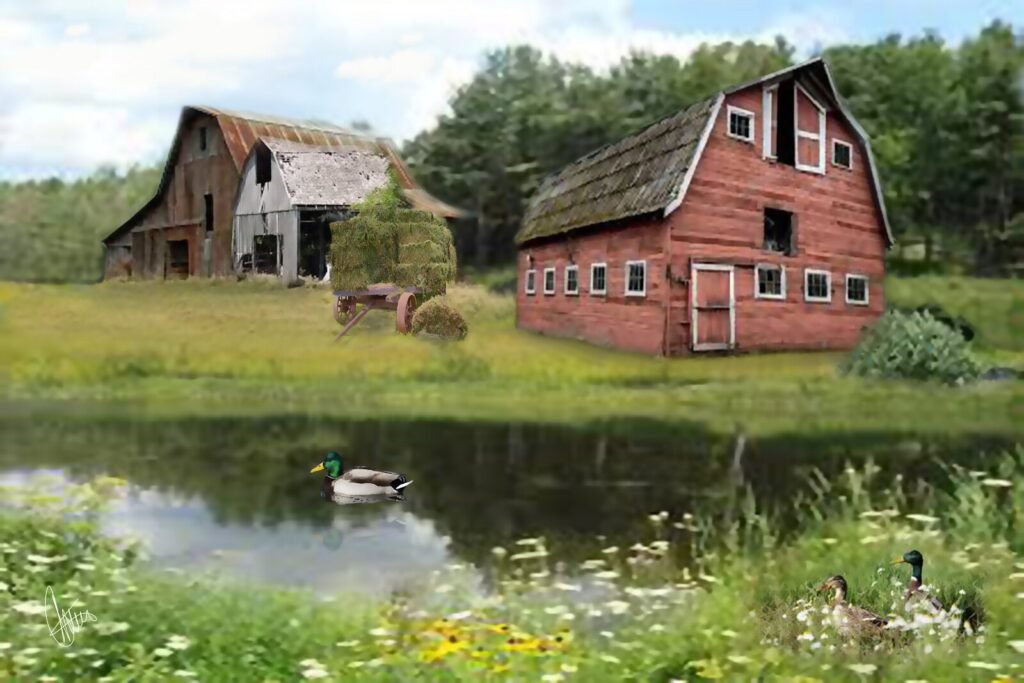
There is a particular kind of beauty that belongs only to things that have been well used and honestly aged, and this composition understands that beauty with rare intimacy. Two weathered barns occupy the middle ground of the scene — one a faded, silvered grey, its roof partially collapsed and open to the sky; the other a warm terracotta red, mossy and softened by decades of weather, its gambrel roofline still holding its shape with quiet dignity. Between them, a wooden hay cart loaded with golden bales anchors the farmyard with a detail so specific and evocative that it functions almost as a timestamp — a record of a working day, a working life, a working land.
In the foreground, a still farm pond mirrors the sky and the barns with glassy calm, its surface broken only by the unhurried passage of a mallard drake, his iridescent green head catching the summer light like a small jewel. Along the pond’s near bank, wildflowers — black-eyed Susans, daisies, and tall grasses — spill into the composition in a profusion of yellow and white, while a pair of mallards rest quietly among the blooms, entirely unbothered by the world beyond their small, perfect corner of it. The artist’s signature marks the lower left with characteristic restraint, claiming authorship without interrupting the scene’s natural flow.
What the work captures so successfully is the emotional texture of rural abandonment that is not quite abandonment — these barns are worn but not forgotten, faded but not gone, and the life that continues around them in the form of ducks and wildflowers and loaded hay carts insists on their continued relevance. The digital treatment softens edges and enriches tones just enough to tip the scene from documentary into elegy — a loving, luminous farewell to a way of life that deserves to be remembered with exactly this much tenderness and care.